Headlamp Lumen and Runtime Claims: 5 Tests for Wholesale Buyers
Headlamp listings are where the number on the box and the light on the trail part company. A wholesale buyer comparing two samples at 3,000 lumens is usually comparing two different measurement methods, one of which was invented by a marketing department. The gap is not small: the same lamp can honestly be called 1,200 lumens or 3,000 depending on whether the figure came from the LED datasheet, a cold-start measurement, or a peak reading taken 10 seconds after switch-on.
These five tests can be run on a bench with equipment most importers already own, and they will separate a real headlamp from a claim within an hour.

1. Measure output with a lux meter, not a datasheet
Put the lamp at a fixed distance from a lux meter — one metre is convenient — and measure the centre of the beam in a dark room. Convert to an approximate luminous intensity, and use the beam angle from the manufacturer to sanity-check the numbers. You are not trying to certify the lumen figure; you are checking whether the sample is in the same order of magnitude as the claim. A lamp sold as 3,000 lumens that measures like a 600-lumen unit is not a measurement dispute, it is a different product.
2. Run a 30-minute output curve
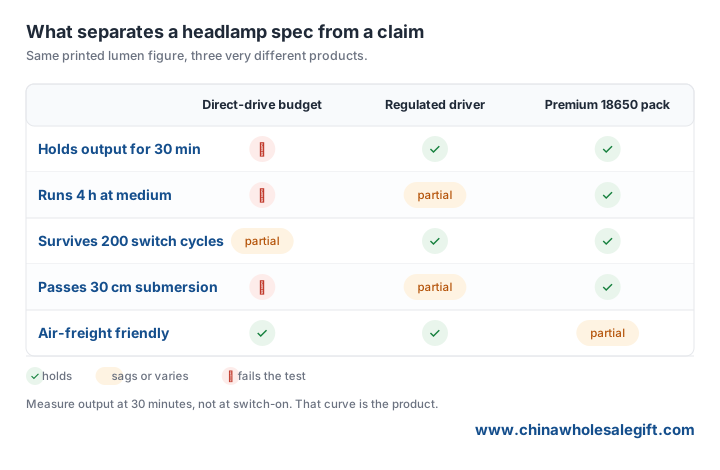
Almost every headlamp is brightest in its first minute. Take a reading at switch-on, then at 1, 5, 15 and 30 minutes. A good regulated driver holds output within 10 percent of the initial figure; a cheap direct-drive circuit will lose 40 percent or more in the first 15 minutes as the LED heats and the battery sags. This curve matters more than the peak number, because it describes the light the user actually has on the trail.
3. Time the actual runtime, on the actual cells
Runtime claims are usually made with premium cells and the lowest output mode. Test at your intended mode with the cells you will ship. AAA alkalines in a three-cell housing behave very differently from a built-in lithium pack, and a lamp that runs four hours on a 18650 may run 40 minutes on three AAA cells. Weigh the battery compartment too: an empty dummy cell or a spacer is a sign the housing was designed for a different configuration.
4. Check the seal and the switch
Water resistance on a headlamp lives in two places: the battery door gasket and the switch boot. Both fail in the same way — they work when new and leak after a season of flexing. Submerge the sample in 20 cm of water for 30 minutes, then open the battery door and look for moisture. Cycle the switch 200 times and repeat. If the switch feels vague at the end of the cycle, it will fail in the field; this is the single most common return reason on headlamps.
5. Inspect the headband and the strain relief
The lamp is the part buyers test; the headband is the part users break. Check the elastic for width and rebound after stretching to 1.5 times its rest length, and check how the cable enters the housing — a moulded strain relief survives, a bare cable entry will fail at the joint within months. On multi-LED housings, confirm that each LED is individually sealed; a single unsealed reflector will fog from the inside and cannot be cleaned.
What to put in the purchase order
Five lines turn these tests into a spec: output at 30 minutes (not peak), mode and cell configuration used for the runtime figure, submersion duration for the water test, switch cycle count, and headband stretch requirement. Ask for the test to be repeated on a production sample, not just the golden sample. Our headlamp range covers single and multi-LED housings — this 12-LED camping headlamp and the smaller focus headlamp with a rubber switch are both available for bench testing before you commit to a wholesale quantity.
Sourcing business gifts for your team?
Send your brief and quantity for a quote and a digital proof.
Get a free quoteRelated products
Headlamp, Adopts 12 High-power LEDs, Suitable for Outdoor CampingCWG31124
 LED Hat Light with 5 High Brightness LEDs, Suitable for Outdoor or MineCWG31125
 Miner Lamp with 1 White 1 Red LED, Suitable for Lighting and WarningCWG31126
 LED Miner Lamp with 56 High-power LEDs, Suitable for Miners and FiremanCWG31127
 LED Headlamp with 2 and 4 Lights, Available in Various TypesCWG31128