Men's Watch Wholesale: 6 Movement and Case Decisions
Two men's watches at the same unit price are rarely the same product, and the gap is almost never the dial. It sits in the movement family, the grade inside that family, the case alloy and its plating, and a water-resistance number that buyers read as a promise it does not make. For men's watch wholesale programmes, those four decisions set the return rate more than any aesthetic choice.
The order matters. Movement before case, case before crystal, and water resistance last, because the rating follows the case construction rather than the label printed on the dial.
Movement family: what the buyer does with the watch
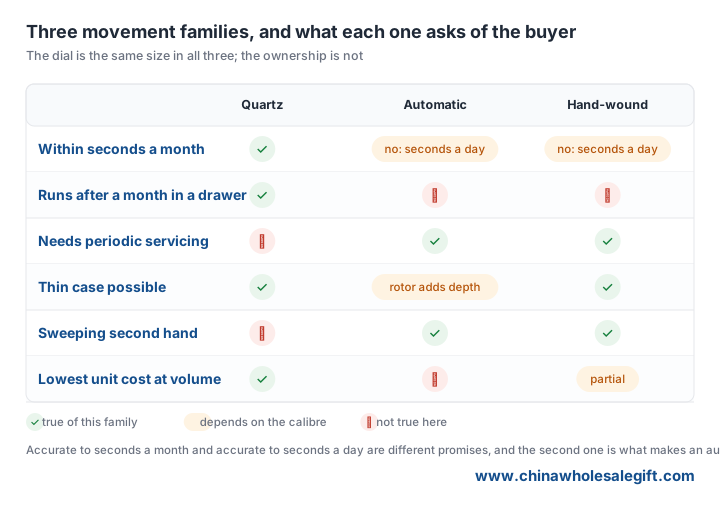
A quartz watch keeps time within seconds a month and runs for years on a cell. An automatic winds itself from the wearer's wrist and stops if left in a drawer over a weekend. A hand-wound mechanical needs a twist every morning. All three sell, but to different buyers, and a gift programme that mixes them under one SKU creates a support problem nobody priced.
The practical split is by wearing pattern. A promotional watch that goes to a conference attendee and then into a drawer should be quartz, because it still shows the right time when it is picked up. A watch sold to someone who wears the same piece daily rewards an automatic, because the motion keeps it running. Hand-wound is a niche for buyers who want the ritual, and it is the hardest to support with spare parts at volume.
The grade inside the family is where the cost hides
"Japanese quartz movement" is not a specification. Within quartz there are standard and high-precision grades, movements with no jewels and movements with several, and date or no-date versions of the same calibre. Ask for the calibre number and the jewel count, not the country.
Automatics vary more. The same case can hold a basic three-hand movement or one with a day-date complication, and the difference shows up in thickness as well as cost. A day-date module adds a disc and a corrector, which is another thing that can fail in the field. For a wholesale programme, fewer complications means fewer returns, and the dial reads cleaner at the sizes most buyers order.
Case alloy, and the plating thickness nobody asks about
Case material decides how the watch ages. 316L stainless steel polishes, resists corrosion and can be brushed; 304 is close and cheaper but pits more readily in humid climates. Alloy cases with chrome or gold-tone plating are the budget route, and their service life is set by the plating thickness in microns, not by the colour name.

Ask for the plating thickness on the case and the caseback edge, because that is where wear starts: a plated case rubs against a shirt cuff all day. Specify a clear lacquer over the plating if the finish is gold tone, and ask whether the caseback is screw-down or snap-fit. A screw-down back with a gasket is the difference between a watch that survives a shower and one that fogs.
Water resistance: the number is a test, not an activity
3 ATM means the case passed a pressure test equivalent to 30 metres of static water. It does not mean a swim, and it does not mean a shower with the crown pulled out. 5 ATM covers splashes and hand washing; 10 ATM is the first rating most buyers should trust around water. The rating follows the gasket, the caseback fit and the crown construction, so a 10 ATM label on a snap-back case is a claim to test rather than accept.
Two checks settle it on a sample. Look at the crown: does it have a gasket and a threaded tube, or does it pull straight out with no seal. Look at the caseback: screw-down with an O-ring, or pressed in. Neither check needs equipment, and both predict how the watch behaves in the first month of real use.
Crystal: what actually scratches
Mineral glass sits around 5 on the Mohs hardness scale; sapphire sits at 9, which is why it resists a key in a pocket and mineral glass does not. Acrylic is softer still and can be polished back with paste, which is why vintage-style pieces use it. On a wholesale watch, the crystal choice changes the perceived quality more than the case finish does, because it is the surface the buyer looks through every day.
If the budget will not stretch to sapphire, specify mineral glass with an anti-reflective coating on the inside and a slightly domed profile. It reads better than a flat uncoated lens at the same cost, and the coating is on the face nobody touches.
Size and lug width: the two numbers that decide whether it sells again
Case diameter for men's wholesale programmes clusters between 38 and 42 mm, with 40 mm the safest single choice across markets. Lug width is the number buyers forget, and it decides your strap programme: 20 mm and 22 mm lugs take the widest range of aftermarket straps, while an odd width locks the customer into your supply.
Give the thickness as well. A 40 mm case that is 12 mm thick wears like a different watch from the same case at 9 mm, and on a wholesale order the difference is one movement choice and one caseback depth. Add the lug-to-lug measurement, because that is what decides whether the watch sits on a smaller wrist without overhanging.
Write six lines into the purchase order: calibre number and jewel count, case alloy and plating thickness in microns, caseback type, water-resistance rating with the test method, crystal material, and case diameter with lug width and thickness. Then ask for one assembled sample to be opened, so the movement, the gasket and the caseback thread can be seen rather than described.
Sourcing business gifts for your team?
Send your brief and quantity for a quote and a digital proof.
Get a free quote


