Container Loading Plan: 20GP vs 40HQ for Gift Programs
Choosing between a 20GP and a 40HQ container is a volume-and-weight calculation, not a guess. Gift programs are usually light and bulky, which means the space runs out long before the weight limit does. That makes the 40HQ attractive, but only if you have enough cargo to fill it. This guide gives you the arithmetic to decide from your own carton dimensions and quantities, and shows where the simple answer breaks down.
Start From Carton Volume, Not Container Name
Before comparing containers, work out what you are shipping. Measure one export carton in centimetres, convert to cubic metres by multiplying length, width and height and dividing by one million, then multiply by the number of cartons. Add a packing allowance for the gaps between cartons and the space the pallet or dunnage takes up; for loose cartons a modest allowance is enough, while palletised loads waste more. This figure is your cargo volume, and it is the number that decides which container fits.
Do the same for weight: carton gross weight times carton count. Gift programs such as tool sets, keychains and small electronics are typically volume-heavy and weight-light, so the space figure will dominate. Heavy or dense products flip that, so always calculate both.
The Two Container Sizes in Plain Numbers
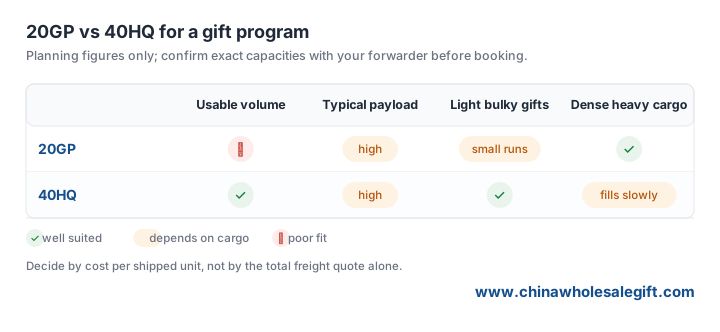
A 20GP holds roughly 33 cubic metres of usable space and is rated for a payload in the tens of tonnes. A 40HQ, the high-cube version of a 40-foot container, holds roughly 76 cubic metres with a similar payload ceiling. The high cube adds internal height over a standard 40-foot box, which is why it is the common choice for light, bulky cargo. Exact capacities vary by carrier and container, so treat these as planning figures and confirm the real specification with your forwarder before you book.
The key point is that the 40HQ gives you about twice the volume for a modest increase in freight cost. If your cargo volume sits close to the 20GP ceiling, the 40HQ can work out cheaper per unit because you avoid paying a premium for a partial container and get room to increase the order.

The Arithmetic That Decides It
Use two checks. First, volume fit: divide cargo volume by the usable capacity of each container and add your packing allowance. If the result is at or below one for a 20GP, that container fits. If it exceeds one, you need the 40HQ or a split shipment. Second, cost per unit: add the freight quote, local charges and expected duty for each option, then divide by the number of saleable units you can actually ship in it.
The cheaper choice is the one with the lower cost per unit, not the lower total freight bill. A 40HQ costs more in total but can win decisively if it lets you ship 2.2 times the volume for 1.4 times the freight. Write the formula into a spreadsheet with your real carton data and both quotes; the answer changes with every quantity break, so recalculate whenever the order size moves.
Where the Simple Calculation Breaks
Three things distort the clean arithmetic. Weight limits still apply: a dense product can hit the payload ceiling of a 20GP while half the space is empty, in which case the larger box does not help. Carton dimensions matter too, because awkward sizes leave unusable gaps; a container that looks full on paper can waste a fifth of its floor area. Finally, port and inland charges differ by container size and destination, so a freight quote from the port of loading is not your landed cost.
If your volume lands close to the 20GP limit, ask the forwarder for both quotes and model the per-unit figure. The small extra cost of the 40HQ is often worth the flexibility, but only if you have the cargo to use it. And if you are still well below 20GP capacity, consider consolidating with another order rather than paying for empty space.
Turning the Calculation Into a Buying Decision
Do this before you commit the order quantity, not after. Measure cartons, compute volume and weight, price both containers, and compare cost per unit at each quantity break. Keep the spreadsheet and update it when the supplier changes packaging, because a smaller carton can change which container wins. A few minutes of arithmetic here prevents the two most common mistakes: overpaying for a half-empty 40HQ, or splitting a shipment that would have fit in one box.
If you want help matching a gift program to an efficient shipping plan, browse our tool set range and send us your target quantity and destination; we can work the container numbers with you.
Sourcing business gifts for your team?
Send your brief and quantity for a quote and a digital proof.
Get a free quote