Carton and Pallet Specs for Mixed Gift Shipments
Mixed gift shipments break in transit for boring reasons: a carton rated for one weight carrying another, a stack that is too tall, or a pallet that does not match the destination standard. None of these are product defects, and all of them show up as damage claims. Five specifications, agreed before the goods leave the factory, remove most of that risk. Here is what to put in the shipping section of a mixed-order purchase order.
Why Mixed Shipments Need Their Own Spec
A single-product order is easy: the factory has packed that item a thousand times and knows the carton. A mixed order combines items with different weights, fragility and shapes in the same container, often in the same carton. The standard packing rule no longer applies. If the spec does not say which item sits at the bottom, how high the stack can go and how the pallet is wrapped, each loader will improvise, and the result varies from container to container. Write the rules down and require a packed-carton photo before shipment.
Spec 1: The Mixed-SKU Carton
Start by defining what goes in a carton. Either each SKN gets its own inner carton and the outer holds a fixed mix, or individual items are packed together in a defined layout. The first is easier to inspect and re-count; the second saves space. Whichever you choose, require an itemised packing list per carton with counts and a carton number. A container of mixed gifts without a per-carton list is almost impossible to reconcile after a short shipment claim.
Mark the cartons clearly with the buyer reference and the contents. If the same outer carton can hold two different mixes, add a colour code or a large letter so the loader cannot confuse them.
Spec 2: Double-Wall Outer and Internal Padding
For mixed loads, a double-wall outer carton is usually worth the small cost increase over single wall, especially on long sea lanes where cartons are handled many times. Add internal dividers or a layer of padding between hard and soft items. A metal item placed directly against a gift box will mark the packaging long before it breaks the product. Ask for a photo of a packed and a dropped test carton, not an empty sample.

State the maximum gross weight per carton. A carton that is too heavy for the people unloading it gets dropped, and no amount of internal padding helps after that. A practical limit keeps handling safe at every step of the chain.
Spec 3: Stack Height and Load Order
Set a maximum stack height in the container and say which cartons may sit at the bottom. Heavy, rigid items go low; light, fragile items go high. If cartons of different strengths share a stack, the weakest one decides the safe height. Ask the supplier to confirm the stacking rule in writing and to photograph the loaded container before the doors close. A stack that looks fine at the factory can settle on a rough road, so leave a margin rather than packing to the theoretical maximum.
Spec 4: Stretch Wrap and Corner Board
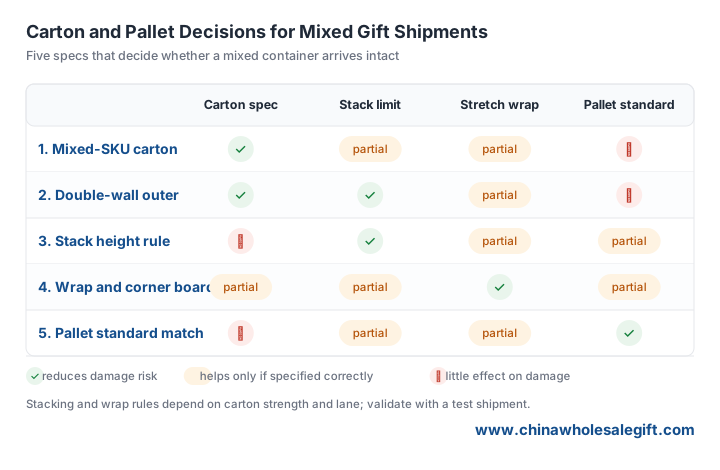
Wrap pallets tightly enough that cartons cannot shift, and use corner board where straps or wrap press on edges. Loose wrap is worse than none in some cases, because it lets the load move as a unit and then catch. For sea shipments, add a moisture barrier; a container can sweat in a way that damages cardboard without ever leaking. Photograph the wrapped pallet from two sides before loading.
Spec 5: Match the Pallet Standard
Confirm the pallet size and type expected at the destination before the goods are loaded. A pallet that does not fit the receiver's racking or handling equipment creates cost at the other end, even if the goods arrive intact. Ask whether the destination requires heat-treated timber and a treatment stamp, and whether a plastic or presswood pallet avoids the issue entirely. If the order will be split across several warehouses, choose the standard that covers the largest share and flag the exceptions on the packing list.
Put all five points in one shipping annex to the purchase order, and require three photos before shipment: a packed open carton, a closed wrapped pallet and the loaded container. Those photos are cheap, and they turn a vague expectation into something you can check. On arrival, inspect the first carton opened and compare it with the photo. If the two differ, you have a record and a basis for a claim. Send your item list and destination, and request a free sample and quote with a carton and pallet plan for the whole shipment.
Sourcing business gifts for your team?
Send your brief and quantity for a quote and a digital proof.
Get a free quote