Bluetooth Speaker Wholesale: 5 Specs That Predict Returns
Most Bluetooth speaker returns are not random. They trace back to five specs that a buyer could have checked on a sample: distortion at volume, Bluetooth version, real battery life, housing rigidity and control feel. None of them needs a laboratory. This article gives the five specs, the simple check for each and the point in the order when the check must happen, so a wholesale buyer can catch a problem before a container lands.
Distortion at Volume Is the First Complaint
A speaker that sounds clean in a quiet showroom can crack at full volume. That is the complaint buyers hear most, and it comes from a driver and enclosure pushed past what they can handle. Play a familiar track at the volume the customer will actually use, not a short burst, and listen for a break in the bass. If the sound splits, the speaker will come back.
Ask the supplier for the rated power in watts and the driver size, but treat those as context rather than proof. The listening test is the proof. Run it on three samples from different boxes, because a batch with one bad driver will pass a single-sample check.
Bluetooth Version and Pairing Behaviour
Bluetooth 5 or later pairs faster and holds a connection better in a crowded room than older versions. The version number alone is not enough, because implementation varies. Test the pairing on two phone models and one laptop, then walk ten metres away with the phone and check that the audio does not drop. A speaker that drops at ten metres will generate returns from buyers who move around a room with their phone.
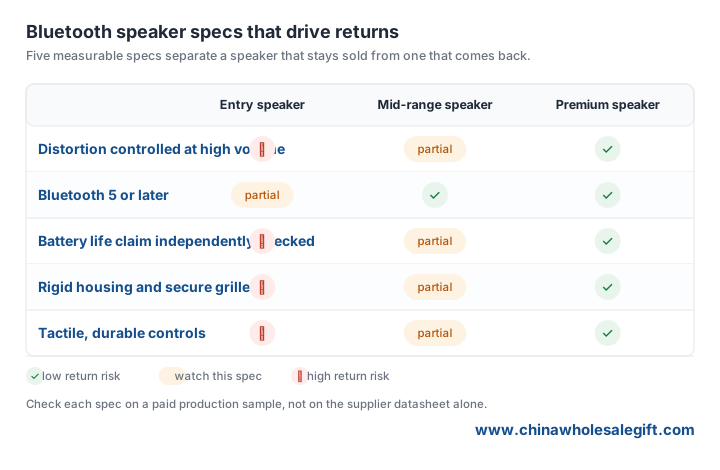
The matrix below scores three speaker tiers on the five return-driving specs. Use it to shortlist a tier, then confirm each spec on a paid production sample rather than trusting the datasheet, which often quotes ideal conditions.
Battery Life Claims Need an Independent Check
Runtime is the spec most often overstated. A quoted figure is usually measured at low volume, which no customer uses. Run your own test: charge fully, play at a realistic volume and note the hour when the sound cuts out. Do it with the sample you would actually ship, since a smaller battery may be fitted in a cost-reduced version.
Also check the charge port and cable. A loose micro-USB or USB-C socket is a common failure point, and a speaker that will not charge is returned even if the sound is fine. Plug and unplug the cable twenty times and check that the connection stays firm.

Housing, Grille and Controls
A flexible housing vibrates and changes the sound, and a grille that flexes can touch the driver. Press the housing firmly and tap the grille; both should feel solid. Check the buttons next. Rubbery controls that give a clear click survive months of use, while small hard buttons can stick or fall off. Press each control repeatedly and confirm it responds at the same pressure each time.
If the speaker is sold as water resistant, ask for the rating and test the seal on the port cover. A cover that does not sit flush lets water reach the charge socket, which is the most common failure in outdoor use. Check the packaging at the same time: a speaker that rattles loosely in its box arrives with the grille already knocked out of shape. Ask the supplier to drop a packed carton once from waist height and open it to check, since transit damage is often mistaken for a factory defect once the goods arrive.
When to Run Each Check
Run the sound and pairing checks on the first paid samples, before you commit to a deposit. Those two specs decide whether the product is worth ordering at all, and they are the most expensive to fix after production. Run the battery, housing and control checks again on a sample pulled from the first production batch, because that is where cost reduction shows up. A supplier may change the battery cell or the button part between the sample and the run without flagging it.
Keep a signed sample from each stage and write the results into a one-page report. When a return pattern appears six months later, that report tells you which spec drifted and gives you a basis for the claim. These checks take minutes and need no equipment, which is why there is no excuse to skip them. For buyers building a wider category, our bluetooth speaker range covers the formats these specs apply to. Send us your target price point and expected volume and we will quote a tier with the five checks recorded against the sample you approve.
Sourcing business gifts for your team?
Send your brief and quantity for a quote and a digital proof.
Get a free quote


