Gift Compliance Pack: Test Reports Buyers Should Demand
A mixed gift order is not covered by a mixed folder of PDFs. Each category answers to a different standard, issued by a different kind of laboratory, with a different notion of what makes the report still valid. The pack that gets rejected at a retailer's compliance desk is usually complete in volume and wrong in coverage: a battery report for the speaker, no report for the plug, and a food-contact sheet that names a simulant nobody tested.
Electrical gifts: UN38.3 is not optional and not a certificate
Anything shipping with a lithium cell needs a UN38.3 test summary, because it is a transport document, not a product safety mark. The test sequence is fixed at eight items: altitude simulation, thermal cycling, vibration, shock, external short circuit, impact or crush, overcharge and forced discharge. Ask for the summary that names the cell or pack model, because a summary covering a 3000 mAh pack does not cover the 10000 mAh pack in the same order.
Then ask for the battery safety report to IEC 62133-2, which is the product-side counterpart and is what most buyers actually mean when they say "battery certificate". The two documents answer different questions and neither substitutes for the other.
The trap: a low-voltage gift does not need an LVD report
A USB power bank runs at five volts, and the Low Voltage Directive covers equipment from 50 to 1000 volts alternating current. A supplier who sends an LVD certificate for a five-volt power bank has sent a document that cannot apply to the product, and a compliance reviewer who knows the scope will read that as padding rather than assurance. What a power bank does need is electromagnetic compatibility, the RoHS restriction on hazardous substances, and the battery documents above, plus a declaration of conformity that names the directives actually relied on.
Ask for the declaration of conformity as a separate page and read the directive numbers on it. CE marking is a self-declaration supported by a technical file; it is not issued by a laboratory, and no laboratory can issue a "CE certificate" in the sense buyers usually assume.

Plugs and adapters: the component that voids the rest
A mains-powered gift with the wrong plug is a non-compliant gift regardless of what the electronics report says. The UK market expects a BS 1363 plug with the appropriate fuse, the European market a Schuko or Europlug to the relevant standard, and a universal travel adapter bundled in the box does not convert one into the other. If the item is sold in several markets, the plug variant is a separate SKU with its own declaration, and the carton marking has to match.
Shortlisting from the power bank range is the moment to fix the plug variant, because the declaration follows the variant rather than the model name. Check the plug on the production sample, not on the photograph. A moulded plug with a recognisable certification body mark on the pin face is checkable in ten seconds, and it is the fastest way to find out whether the factory bought a compliant cord set or assembled one.
Food contact: the report names a simulant, a time and a temperature
For a mug, a lunch box or a cutlery set, a food-contact report is only meaningful with its test conditions attached. European framework regulation 1935/2004 sits above material-specific rules, and the practical test is a migration test using a specified simulant, at a specified temperature, for a specified duration, chosen to match the intended use. A report that says "food contact: passed" without those three parameters cannot be matched to a use case, and the German LFGB requirements and the US food-contact framework ask for the same kind of specificity in different words.
Match the conditions to the way the gift will actually be used. A mug for hot coffee and a lunch box for cold food are different exposure scenarios, and a report generated for the wrong one is not evidence for the other.
Toys and children's items: the parts are not interchangeable
EN 71 splits into mechanical and physical properties, flammability, and migration of elements, and a supplier who sends one part has sent a third of the file. For the US market, the lead limits separate substrate from surface coating, and the phthalate restriction applies to plasticised parts rather than to the whole item, so the plastic print on a wooden toy is exactly where the question lands.
Children's items also attract an age-grading judgement that no laboratory can make for you. A plush toy with a sound module sits in two categories at once, and the file needs the electrical evidence as well as the toy evidence.
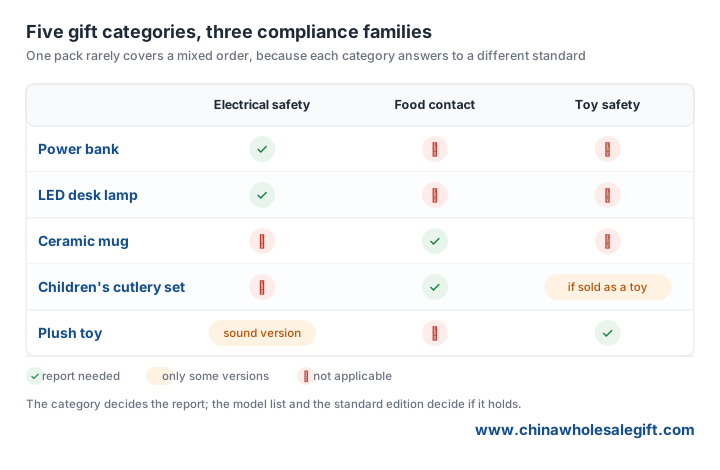
Four traps that void a report which looks valid
The first is the standard version. Reports are written against an edition with amendments, and an edition superseded two years ago is a document about a different test. Ask for the edition on the cover page and compare it with the current one rather than with the date on the report. The second is model coverage: a report for one model in a family is evidence for that model, and a family claim needs the model list inside the report.
The third is who the report was issued to. A report addressed to a trading company does not bind the factory that will actually make the goods, and a buyer who needs recourse wants the production site named. The fourth is the laboratory's accreditation for the specific method, which is a different question from the laboratory being well known. Put those four checks into the enquiry alongside the category list, and the compliance pack arrives correct the first time instead of three emails later.
Sourcing business gifts for your team?
Send your brief and quantity for a quote and a digital proof.
Get a free quoteRelated products
 Credit Card-Size Power BankCWG57296
 5000mah magic mirror power bank smart universal power bankCWG58502
 High capacity dual USB mobile power bank 10400mah with LED torchCWG58508
 Power bank car jump start power bank car jump start 10000mahCWG58515
Engraved or printing logo crystal power bank with LED LightingCWG59083