Lady Watch Wholesale: Bracelet vs Strap Mix by Market
A ladies watch order is rarely one band type. It is a mix, and the mix is set by the market and the sales channel rather than by taste. Two buyers with the same case and the same dial will order different ratios because one sells into a humid coastal city through a chain of accessory shops and the other sells a corporate gift into a temperate climate. Get the ratio wrong and half the pallet becomes the discount line. Get it right and the same case sells twice, once on metal and once on leather.
Start From Climate and Wear Pattern
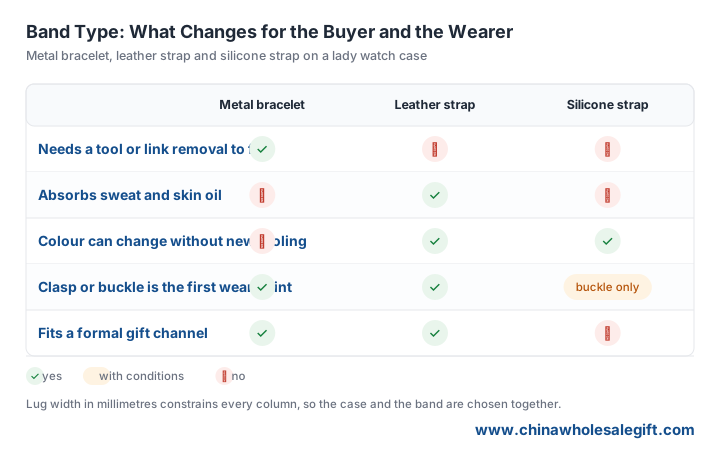
Skin chemistry and climate decide more of the mix than fashion does. A metal bracelet stays cool, wipes clean and does not absorb anything, which is why it holds up in humid markets and on watches worn daily. A leather strap absorbs sweat and skin oil, darkens at the buckle and reaches the end of its life long before the movement does. That is acceptable in a temperate market where the watch is worn to work and taken off at home, and it is a return in a market where the same watch is worn in the heat all day.
Ask the buyer two questions before quoting a ratio: how the watch will be worn, and whether the customer will keep it or gift it. A gifted watch is judged on the box and the first impression; a self-purchased watch is judged on week three, when the strap has been through a few hot days.
Bracelet: Sizing, Links and the Returns Question
A metal bracelet has to fit, and fitting means removing links. That turns a sale into a small service: the retailer needs a sizing tool, a steady hand and a place to put the removed links so the customer can add them back. In a market where the retailer will not size a watch at the counter, a bracelet becomes a return, and the return rate on an unsized bracelet is the number that decides the ratio.
Ask for the link type on the sample. Pins and collars need a tool and a push; screw links need a driver and are easier to service but cost more; a folded link with a friction pin is the cheapest and the one most likely to loosen. Send the sizing tool with the order if the channel cannot supply its own, and put the instruction card in the box.
Clasp quality decides the second year. A folding clasp with a push-button release is a different component from a simple fold-over, and on a plated bracelet the clasp is where the plating wears first because it rubs against itself every time the watch is taken off. Ask which clasp is quoted and whether the plating on the clasp matches the band.
Strap: Colour as a Cartridge, Not a Range
A leather strap is cheap to change and cheap to re-order, which makes it the flexibility in a mixed order: the same case can ship in black, tan and navy without new tooling, and a market that rejects one colour has not rejected the watch. Treat the strap as a cartridge that can be swapped per market, and negotiate the strap as a separate line so a later re-order can move the colour without touching the case.

Strap thickness and the lug gap matter more than the colour. A thick strap on a narrow lug gap puckers at the spring bar, and a thin strap on a wide gap shows the bar and reads as unfinished. Specify the lug width in millimetres, the strap thickness at the lug, and the buckle type, then test the spring bar by pulling the strap sideways with the watch held still.
Case Size and Band Width Are One Decision
A 32 mm case with an 18 mm band reads differently from a 38 mm case with the same band. The proportions are fixed by the lug spacing, so the case and the band cannot be chosen independently. Photograph the sample on a wrist, not flat: a bracelet that looks generous on a table can look narrow once the links curve around the wrist and the case appears wider than the band.
Silicone sits between the two. It does not absorb, it takes colour easily, and it survives water and sport; it also reads as casual, which limits it in a gift channel that wants a formal look. On a mixed pallet, silicone is the volume filler for a younger price point rather than a substitute for leather at the same price.
Building the Mix by Channel
Corporate gift. One style, one colour, boxed. The ratio question is mostly moot, and a leather strap with a debossed logo is easier to personalise than a bracelet, where the logo has to go on the case back or the clasp.
Retail accessory shop. A three-to-one split that favours bracelet in humid markets and leather in temperate ones, with a small silicone line for the lower price point. Keep the case identical across all three so the display reads as one range.
Wholesale pallet. Mixed cartons by band type rather than by colour, so a reseller can order a small quantity of each without opening a dozen cartons. State the carton breakdown on the order, not the pallet average.
What to Write on the Order
Case size and lug width in millimetres; band type per SKU with the ratio; bracelet link type and clasp type; strap material, thickness and buckle; plating specification with the clasp included; sizing tool and instruction card if the channel needs them; and the carton breakdown for a mixed order. Add the market and the wear assumption, because the next re-order will be judged against it.
Send the case size, the market and the channel. We will quote a bracelet and a strap version on the same case with a suggested ratio for that market, and ship both on a wrist so the proportion question is answered before the deposit. See the full lady watch range for cases that take either band.
Sourcing business gifts for your team?
Send your brief and quantity for a quote and a digital proof.
Get a free quote


