Headlamp IP Ratings: What IP65 Really Covers
IP65 on a headlamp box means two things and rules out a third. The six means dust-tight: no dust ingress after the test. The five means water projected as a jet against the enclosure does not cause harm. It does not mean the lamp survives being dropped in a puddle, and that gap between a jet and an immersion is where most headlamp complaints begin.
Two Digits, Two Different Tests
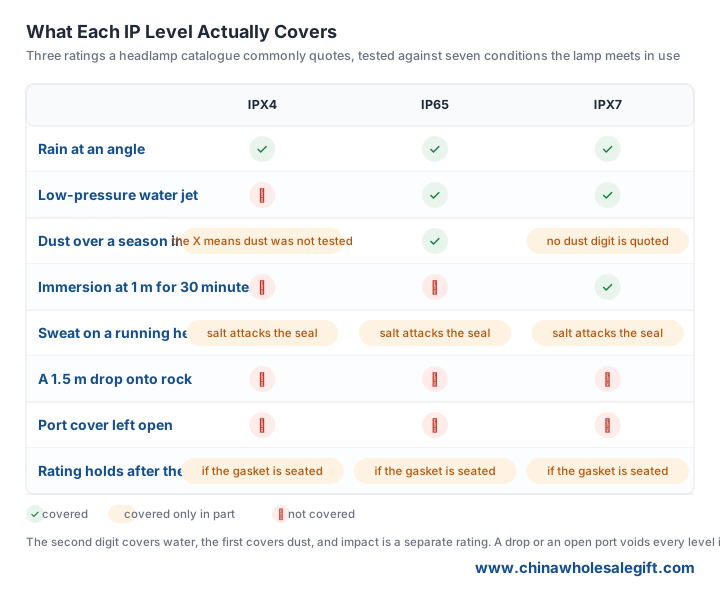
The IP code comes from IEC 60529 and its two digits answer two separate questions. The first digit covers solids, from a large body part down to dust; the second covers water, from dripping to prolonged immersion. A digit of X means that property was not tested, which is why IPX4 and IP65 are not on the same scale: IPX4 tells the buyer nothing about dust, and IP65 tells them nothing about immersion.
Read the code as two separate claims and the catalogue becomes easy to compare. A lamp rated IPX4 is a rain lamp. A lamp rated IP65 is a dusty-site lamp that also tolerates a hose. A lamp rated IPX7 is a lamp that can be submerged, with no dust claim attached unless a first digit is given as well.
IPX4: Rain, and Nothing More
The four in the second position is a splash test: water sprayed from any direction at a controlled rate for a set time. It covers rain blowing at an angle, a wet hand, and a splash from a puddle. It does not cover a jet from a hose, and it does not cover immersion, so a lamp that slips into a puddle during a night run is outside its rating.
For a promotional headlamp sold into a market where the lamp is worn for an hour in the rain, IPX4 is honest and sufficient. The failure to avoid is presenting IPX4 as if it were waterproof. A buyer who reads only the marketing line and dunks the lamp will return it, and the return will be counted against the supplier who printed the number.
IP65: Jets and Dust, Still Not Immersion
The five in the water position is a low-pressure jet test: a nozzle delivering water at a defined rate and pressure, directed at the enclosure for a defined duration. It is a harder test than splashing and a much easier one than immersion. The six in the solids position is dust-tight: after the dust test, no dust enters the enclosure.
For a headlamp used in a workshop, on a building site or in a grain store, IP65 is the useful level. Dust is the failure mode that kills a lamp slowly, by coating the reflector and gumming the switch, and it is the reason a lamp that survives rain can still fail in a dry environment. If the buyer needs both dust and immersion, the code has to carry two digits that say so, for example IP67 or IP68, and the quotation should show the report.
IPX7 and IPX8: Immersion Is a Different Claim
The seven is immersion at a stated depth and duration, conventionally one metre for thirty minutes. The eight is immersion beyond the conditions of the seven, with the depth and duration agreed between the buyer and the supplier, which means an IPX8 claim without a stated depth is not a specification. A lamp rated for two metres for an hour and a lamp rated for ten metres for a week can both be called IPX8.
Immersion is where headlamps get interesting, because the test is done in still fresh water at a controlled temperature and the real world is neither still nor fresh. Salt water attacks the plating and the seal, and a lamp that passes the lab immersion can still corrode at the switch after a season of sea fishing. Treat IPX7 as a floor, not a warranty.
Where the Rating Stops: Seals, Salt, Drops and Open Ports
Every IP number describes a new lamp with its seals correctly seated. The parts that move are the ones that fail: the battery door gasket, the switch membrane, and the rubber cover over a charging port. A cover left open during a charge, then closed without checking that the lip is seated, turns an IPX7 lamp into an unrated one, and nothing on the box warns about it.
Impact is not in the IP code at all. The IK rating covers mechanical impact, and a headlamp that survives a hose can still crack a lens when it falls onto rock. A supplier quoting IP65 should be able to say what the lens and the housing are made of, because that is what decides the drop, not the IP number.
What to Ask Before a Bulk Order
Ask for the test report, not the claim. The report names the standard, the laboratory, the digits tested and the duration, and it is the document that settles a dispute at the destination. Ask as well whether the report covers the production version: a sample with a glued gasket and a bulk order with a taped one are different products with the same drawing.
Add two practical checks to the sample stage. Open and close the battery door ten times, then repeat the splash test, because a gasket that only seals when new is not a gasket. And confirm the charging port cover is attached to the housing rather than loose in the box, since a cover that can be lost is a rating that can be lost with it.
Send us the intended use, the market and the level you need to print on the box, and we will match the lamp and the report to it before the order is placed.
Sourcing business gifts for your team?
Send your brief and quantity for a quote and a digital proof.
Get a free quote