Cutting Board Material: Acacia vs Bamboo vs PP
Acacia, bamboo and polypropylene are sold as if they were interchangeable kitchen boards, and at a glance they are all a flat surface with a handle hole. In use they behave nothing alike: one takes a knife edge and drinks oil, one is harder than most hardwoods and hides a glue line, and one is the only material of the three that will survive a dishwasher without a written care instruction. The choice is settled by four lines, not by the look of the grain.
The four lines that decide a cutting board
Every material argument in this category comes down to the same four questions, and a board that wins on one usually loses on another:
- Knife marks: does the surface scar, and do the scars hold moisture and food residue.
- Water uptake: how much moisture the material takes on, and what happens when it dries.
- Cracking and warping: whether heat, soaking or a dishwasher changes the shape.
- Food-contact compliance: which regulation the material is actually covered by, and what document proves it.
That fourth line is the one that decides export programmes. Plastics have a harmonised rule in the EU; wood and bamboo do not, which means the compliance story has to be built from national guidance and material declarations instead of a single certificate.
Acacia: dense, heavy, and thirsty at the edges
Acacia is a dense hardwood, and density is why it sells. A thick acacia board resists deep scoring better than most softwoods, and the closed grain takes an oil finish that reads as premium on a shelf. The catch is that wood moves. A board that is soaked and left wet will swell at the end grain, dry unevenly and cup or split along the glue line.
In production the risk sits in two places: the moisture content at assembly, and the finish. Boards glued at a high moisture content will open at the seam once they reach a dry warehouse. A food-safe oil and wax finish slows water uptake but does not stop it, so the care instruction is part of the product, not an afterthought. Acacia is also heavy — a 40 x 30 cm board at 3 cm thick will feel substantial, which some buyers want and some markets reject on shipping cost.
Bamboo: hard surface, glue line is the risk
Bamboo is a grass, and a bamboo board is a laminated composite: strips or nodes glued and pressed into a slab. On the surface it is hard, often harder than the hardwood it imitates, and it resists knife marks well. The failure mode is not the bamboo. It is the adhesive and the lamination.
Three points belong on the spec sheet. First, the formaldehyde class of the adhesive — an E1 or equivalent declaration, because a board sold for food contact is the wrong place to save on glue. Second, the ply construction: a three-layer board with cross-laminated core is more stable than a single-layer slab, and it is what stops the board from splitting along the strip joints. Third, the end grain. Bamboo absorbs water fastest where the strips are exposed, so a sealed edge or a recessed handle that avoids exposed end grain extends the life of the board more than any surface treatment.

PP: the only one that can go in a dishwasher
Polypropylene is a thermoplastic, non-porous, and dimensionally stable at kitchen temperatures. A PP board can be washed in a dishwasher, soaked, and stacked without swelling — which is why it dominates the value end of the market and the food-service channel. It is also the cheapest of the three per unit at volume, and the easiest to print or mould into a shaped board with a juice groove.
Its weakness is the knife. Every cut leaves a mark, and deep grooves become places where residue sits if the board is only wiped. A textured surface hides the marks and improves grip; a smooth one looks better in a photograph and worse after a year. PP also softens above roughly 100 to 120°C depending on grade, so a board left against a hot pan will warp, and a warp is not recoverable.
Compliance is where PP is actually easier than wood. Food-contact polypropylene is covered by a defined framework — EU 10/2011 for plastics in the European Union, and FDA 21 CFR 177.1520 in the United States — so the supplier can produce a declaration of compliance naming the regulation and the migration test results. That document is worth more in a retail audit than any certificate about the wood being "natural".
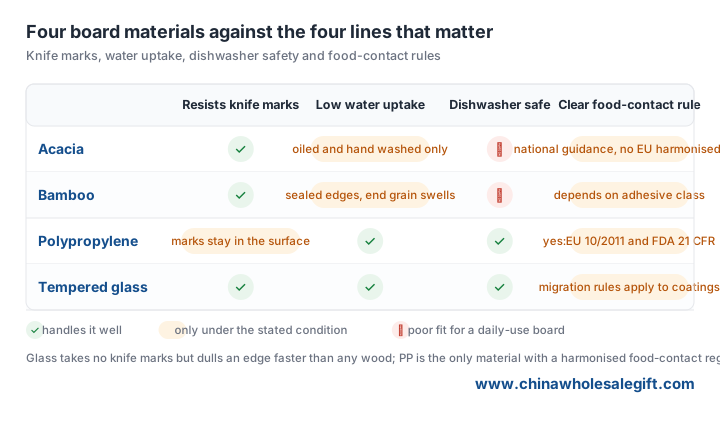
Tempered glass is the fourth option a buyer will be offered, and it belongs in the comparison for one reason: it takes no knife marks at all. It also dulls a knife faster than any of the others and can shatter if dropped on a tile floor, which is why it usually sells as a serving or prep surface rather than as the board a cook reaches for daily.
What to put on the order spec
Four lines, written as measurements rather than adjectives, remove most of the disputes in this category:
- Material and grade: acacia, bamboo with ply count and adhesive class, or PP with the food-contact grade named.
- Dimensions and thickness in millimetres, measured at three points, because a warped board is out of tolerance before it ships.
- Moisture content for wood and bamboo, stated as a range and checked at packing.
- Compliance document: EU 10/2011 declaration for PP, adhesive and finish declarations for wood and bamboo, with the migration or formaldehyde test referenced.
Add the care instruction you intend to print, because it changes the material choice. A board sold with "hand wash and oil monthly" can be acacia. A board sold with "dishwasher safe" has to be PP or glass, and promising otherwise is a returns programme with a launch date.
Send the market, the care instruction you want to print and the price band you are buying into, and the material follows from those three rather than from the photograph. Cutting boards for wholesale and gift programmes are quoted per project; request a sample and a quote with your quantity and target market.
Sourcing business gifts for your team?
Send your brief and quantity for a quote and a digital proof.
Get a free quote