Tool Set Steel Grades: CRV vs Carbon Steel for Gift Kits
A gift tool kit is judged twice: once when the box is opened, and again months later when the screwdriver is actually used. Steel grade decides the second judgement, and it is the line most order sheets leave blank. The comparison that matters is not carbon steel against chrome vanadium as brands, but what each grade buys on three separate lines: hardness under torque, rust resistance in a drawer, and cost per kit.
Three Lines That Matter: Hardness, Rust and Cost
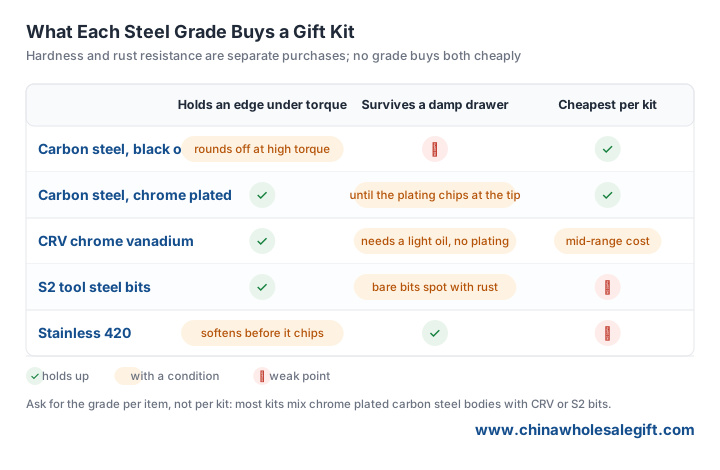
Hardness decides whether a tip deforms when it is used on a tight screw. Rust resistance decides whether the tool still looks new when a customer opens the drawer a season later. Cost decides which of the two the buyer can afford across a full kit of thirty or forty pieces. The trap is that these three lines trade against each other, and a supplier who quotes one grade for the whole kit is usually quoting the cheapest combination that still photographs well.
The number to ask for is not a brand name but a rockwell figure per item, plus the surface treatment. A tool at a given hardness with no treatment will rust; the same tool with chrome plating will resist rust until the plating wears at the working tip, which is exactly where it wears first.
Carbon Steel: What Black Oxide and Chrome Plating Actually Change
Carbon steel is the base of most promotional tool kits because it is cheap, machines well and takes a heat treatment that puts it in a workable hardness range. What changes between a good and a bad kit is the surface. Black oxide is a conversion coating that darkens the steel and holds a light film of oil; it protects against handling moisture but not against a damp drawer, and it rubs off at contact points.
Chrome plating is the version buyers see in most gift kits. It gives a bright finish and real corrosion protection, and it hides machining marks. Its weakness is at the tip: plating on a Phillips or Pozidriv point is thin, it chips under load, and once it chips the steel underneath starts to spot. The failure mode is cosmetic first and functional second, which matters for a gift because the first complaint is usually appearance.
If the kit uses plated carbon steel, ask for the plating thickness and specify that tips are polished after plating rather than before. It costs little and removes the flaking edge that starts the rust.
CRV: Where the Vanadium Earns Its Cost
Chrome vanadium steel is the grade most gift kits advertise on the box, and the reason is toughness rather than hardness alone. The vanadium addition refines the grain so the tool resists shock: it bends before it snaps, which is what a buyer wants from a screwdriver used on a stuck screw. In a gift kit the practical difference is that a CRV tip does not mushroom after a few uses, so the tool still fits the screw head.
CRV is normally supplied with a polished or satin finish rather than heavy chrome, so the rust line depends on the packing. A kit that sits in a plastic tray inside a colour box is fine; a kit in a fabric roll that gets stored in a garage will show spots unless the tools are oiled or the roll is lined. This is the point where the box design affects the steel choice, which is why the two decisions should be made together.
Stainless and S2: The Two Special Cases
Stainless steel, usually a martensitic grade in this category, buys rust resistance at the cost of hardness: it resists staining in a bathroom or a kitchen drawer but softens at the tip sooner than CRV. It is the right answer for kits aimed at household use near water, and the wrong answer for kits that will be used on machinery.
S2 tool steel is the opposite trade. It is used for bits in bit sets because it holds hardness at high torque, and it is normally left with a light coating or a sandblasted finish. Bits in S2 are a genuine upgrade inside a kit that otherwise uses plated carbon steel, and that combination is common: plated bodies, S2 or CRV bits. Ask which items are which grade instead of accepting one grade for the whole box.
What to Specify on a Gift Kit Order
Specify per item, not per kit. A workable order sheet lists the grade and the surface treatment for each tool family: screwdriver bodies, bits, pliers, tape measure blade, and any cutting item. Then add two acceptance checks that can be run on a sample in a few minutes: torque a sample tip against a hard screw and look for deformation, and wipe a sample with a damp cloth and leave it overnight to see whether the finish spots.

Send the target retail price and the market, and we will quote the household tool set range with the grade and treatment listed per item, so the kit is priced against a steel specification rather than a photo of a shiny box.
Sourcing business gifts for your team?
Send your brief and quantity for a quote and a digital proof.
Get a free quote


