Men Watch Straps: Leather vs Silicone vs Steel
The strap decides more of a men watch sale than the dial does, because the strap is what the buyer touches every day and what wears out first. Leather, silicone and steel are not three quality levels of one product; they are three different answers to three different questions about climate, dress code and how the watch will be worn. Pick by the market you are shipping into, then specify the lug width, because that single measurement is what makes the strap replaceable.
What Each Strap Family Is Actually Good At
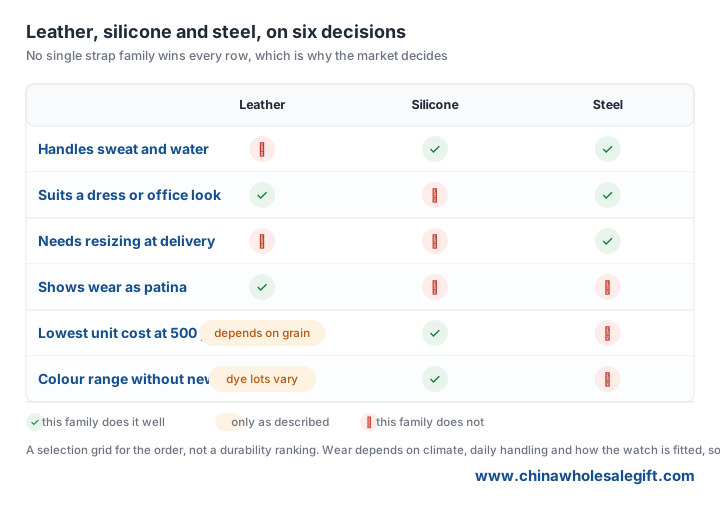
Leather is the dress answer. It reads as office and formal, it takes stitching, edge paint and a debossed logo beautifully, and it is the cheapest way to make a modest case look considered. What it does not do is survive sweat: a leather strap worn daily in a humid climate darkens at the buckle, curls at the lugs and cracks at the fold within a season. That is not a defect, it is the material behaving normally, and a buyer who ships leather into a tropical market should plan to sell spare straps.
Silicone is the utility answer. It handles water, sweat and sunscreen, it cleans with soap, and it is the only one of the three that can be produced in a wide colour range without a new tool for each colour. The trade-off is dress code: silicone reads as sport, and on a slim dress case it looks like a replacement strap rather than an original one.
Steel is the durable formal answer. A link bracelet survives years of daily wear, it can be sized to the wrist, and it carries the perceived value of the watch better than either alternative on a mid-price case. It is also the heaviest, the most expensive to tool, and the only one that needs a sizing step at delivery, which matters when the watch is a gift shipped directly to an end user.
Lug Width and Spring Bar Decide Everything
Twenty and twenty-two millimetres cover most men watch cases, with eighteen on the slimmer 38 to 40 mm pieces. Write the lug width on the order in millimetres and photograph it with a caliper on the sample, because a strap that is one millimetre off will either not fit or will leave a visible gap at the lug.
Two more numbers belong beside it. Taper is the width at the buckle end, commonly two millimetres narrower than the lug width, and it is what makes a strap look proportioned rather than slab-sided. Thickness decides whether the strap rubs the case: a four-millimetre strap on a thin case will not sit flat, and the spring bar will take a permanent side load.
The spring bar itself is worth one line. Quick-release bars let the end user change straps without tools and cost little at volume; drilled lugs make the change possible with a pin tool; a plain friction bar means the strap is effectively permanent for most buyers. If the plan is to sell a second strap, ask for quick-release on both.
Matching Material to Market and Season
Humid and coastal markets. Silicone or steel. Leather will sell, and it will come back. If leather is required for the look, ship a spare strap per watch rather than a promise that the strap will last.
Cold, dry winters. Leather is the better choice and the failure mode changes: leather cracks at the fold rather than darkening, so specify a softer temper and avoid a very stiff finished leather on a thin strap.
Corporate gifting. Leather on a mid-price case, engraved or debossed at the buckle end. The recipient is unlikely to wear it in water, the presentation matters more than the durability, and the deboss is easier to place on leather than on a link bracelet.
Sports and outdoor gifting. Silicone, with the case colour matched. This is also the only family where a bright colour range is realistic at low volume, so it is the natural choice for a campaign that needs four colours.
Retail and duty-free. Steel, sized. The buyer compares it against known brands on a shelf, and a link bracelet carries the weight and finish expectations of that comparison. Expect to hold sizing links and a small tool at the counter.
Cost, MOQ and the Two-Strap Strategy
Leather and silicone are usually quoted per colour, which is why a four-colour silicone programme is cheap to extend and a four-colour leather programme is not: each colour is a separate material buy, and dye lots are what make a reorder not quite match. Steel is quoted per bracelet, and the sizing links are part of the unit rather than an extra.
The pattern that works across all three is to ship one watch with two straps: the material that matches the market, plus the opposite one at a low ratio. Leather plus silicone covers office and weekend; steel plus silicone covers retail and sport. It raises the unit cost modestly and it removes the most common return reason, which is the customer disliking the strap rather than the watch.
What to Put in the Order

Lug width, taper and thickness in millimetres. Three numbers, caliper-verified on the sample. This is the line that makes the strap replaceable and the watch serviceable.
Buckle or clasp, and its finish. A pin buckle, a deployment clasp, or an integrated clasp on steel. The finish has to match the case, and a light gold buckle on a steel case is the mismatch buyers notice first.
Spring bar type. Quick-release, drilled lugs or plain. State whether the end user is expected to change straps, and specify accordingly.
Colour split by market. Give the quantity per colour, not a colour range. On leather this also fixes the dye lot; on silicone it is the difference between one mould run and four.
Spare strap ratio. If the plan includes a second strap, fix the ratio per carton so the packing list and the watch count reconcile without repacking at the warehouse.
See the men watch range we build most often, then send us the case, the market and the season you are selling into. We will return a strap recommendation with the lug width, taper and spring bar written into the specification, and a two-strap option priced against the single-strap build.
Sourcing business gifts for your team?
Send your brief and quantity for a quote and a digital proof.
Get a free quote


