Metal Bottle Opener Casting vs Stamping: Cost and Strength
Two suppliers quote the same bottle opener shape and the prices sit far apart. One is die casting the body in zinc alloy, the other is stamping it from sheet steel and bending the lip. Both open a bottle. The difference shows up in the tooling invoice, in the unit price at your quantity, and in what happens when somebody uses the opener as a lever. Here is how the two processes split, and where each one is the right answer.
The Two Processes in Plain Terms
Die casting injects molten zinc alloy into a steel mould under pressure. The mould carries the full three-dimensional shape, so the finished part comes out with thickness where you want it, recessed panels, and detail on both faces. One mould makes every unit in the order, and the same mould can usually be modified later by cutting a new cavity insert or reworking the logo area.
Stamping starts from flat sheet, cuts a blank with a die, then forms it in one or more press steps. A progressive die can blank, pierce the keyring hole, form the lip and trim in a single pass. Sheet thickness is fixed by what you buy, so a stamped opener is as thick as the coil it came from, usually 1.2 to 2 mm. Detail exists on the face that touches the die; the back is flat or shows a shallow reverse.
Where the Money Goes
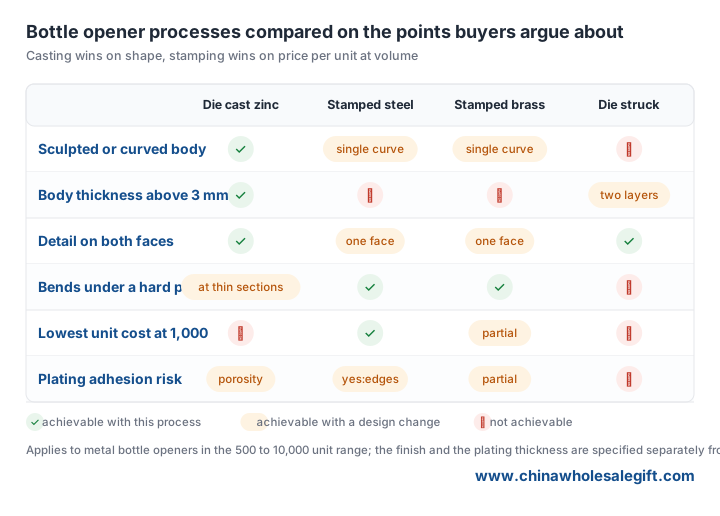
Casting front-loads the cost. The mould is the largest single line in a casting quote, and it does not care how many parts you order. At 500 pieces the mould is spread over 500 units and dominates the unit price; at 50,000 pieces it almost disappears. Stamping front-loads less: the die costs a fraction of a mould, and the press time per part is short, so the unit price at 1,000 pieces is usually the lowest of the metal processes.
The practical break-even sits where the higher unit price of casting crosses the tooling saving of stamping. Buyers who order once a year in the low thousands usually find stamping cheaper overall. Buyers who order repeatedly from the same mould, or who need a shape a flat sheet cannot produce, find casting cheaper across the program even though the first invoice is larger.
Strength at the Lip and the Pivot
The lip is a lever, and a lever multiplies whatever force the user applies. A cast zinc body handles this well when the section behind the lip is thick and the corners are radiused; it fails when the design thins the section to save material, because zinc alloy at 1.5 mm under a hard pull can crack rather than bend. A stamped steel lip in 1.5 mm sheet bends before it breaks, which is the safer failure for a promotional item that will be used carelessly.
Test it the same way for either process. Clamp the body in a vice, hook a known weight on the lip, and leave it for ten minutes: a load the opener is expected to see in service plus a margin. Then bend the lip 15 degrees by hand and look for a crack at the root, a lifted plating edge, or a permanent set that stops the lip seating on a cap. Photograph the lip root before and after. That photograph tells you more about the process choice than any datasheet.
Detail, Thickness and the Finish
Thickness decides which process can deliver the design. Anything above 3 mm, any undercut, any recessed panel deeper than the sheet, and any shape with a compound curve belongs to casting. At 1.2 to 2 mm, flat with a folded lip, stamping is faster and cheaper and the strength is adequate for opening bottles.
Finish behaves differently on the two bodies. Cast zinc has surface porosity, so plating needs a copper strike and a nickel layer before chrome; skip the copper and the plating blisters at the pores within months. Stamped steel plates more predictably on the faces but thinly on the cut edges, and those edges are exactly where a keyring opener rubs in a pocket. On brass, plating adheres well and the edge wear shows as a warm colour change rather than a rust spot.
Logo methods follow the same logic. Cast bodies take the logo in the mould, so it is part of the shape and cannot rub off. Stamped bodies take a laser or etched logo on the flat face, which is cheaper to change per order but sits on top of the plating. If the artwork may change between orders, stamping plus laser is the flexible route; if the logo is fixed for years, casting the mark into the mould gives the most durable result.
Choosing by Order Size and Use
Order under 1,000 pieces with a flat, simple body: stamp. The die cost is small, the unit price is the lowest available, and the shape is achievable in sheet. Order 1,000 to 5,000 with a logo that may change: stamp with a laser mark. Order any volume with a sculpted body, a bottle-shape or tool-shape design, or thickness above 3 mm: cast, and accept the mould cost as part of the program rather than the order.
Two clauses belong on the purchase order whichever process you choose. State the material and the sheet thickness or the casting alloy, and state the lip test with the load and duration. Add the plating stack, copper and nickel included, because that is the line most often quietly removed to hit a price.
Send the shape, the quantity and the finish, and we will quote both processes so you can compare the tooling and the unit price on the same drawing. Browse the metal bottle opener range for bodies already tooled in each process, then request a sample with the lip test written into the order.
Sourcing business gifts for your team?
Send your brief and quantity for a quote and a digital proof.
Get a free quote


