Gift Wholesale Margin Math: 4 Numbers to Model
Wholesale gift margin is usually modelled as one subtraction: buy at one price, sell at another, keep the difference. That subtraction is wrong often enough to be dangerous, because it leaves out three numbers that decide the outcome, and it hides the leaks that happen between the four numbers you do model. A watch bought at 2.10 and sold at 3.50 is not a 40 percent margin until freight, sell-through and dead stock have been counted.
Number one: landed cost, built line by line
The supplier's unit price is the first line of landed cost, not the whole of it. Add the freight per unit, which is the total freight divided by the units actually in the cartons, not by the units you ordered. Add duty and import charges at the rate that applies to the specific product category, then add the cost of getting the goods from the port to your warehouse. On light, low-value gifts the freight line is frequently larger than the unit price, which is why a 12 percent saving on the product can disappear in a carton that cubes badly.
Two habits make this number reliable. Ask for the master carton dimensions and units per carton before you compare quotes, so you can compute freight per unit yourself. And record the landed cost per SKU, not per order, because a mixed container hides the fact that one SKU is carrying the freight of three others.
Number two: realised sell price, not list price
List price is a starting point. What you actually collect is list price minus trade discounts, minus any promotional support, minus the markdown you take when a line does not move, and minus the cost of the bundle or the free gift you added to close the deal. A promotional distributor quoting a 3.50 unit price with a 15 percent trade discount and one free unit per ten is not selling at 3.50; the realised price per unit is lower, and the margin calculation has to use the realised number.

The discipline is to write the discount structure down before the order, in the same units as the cost. If a customer will take 500 units at a 10 percent discount, that discount is a cost line per unit and belongs in the model. Deciding it afterwards turns a modelled margin into a surprise.
Number three: sell-through and the cash cycle
Margin percentage says nothing about how long your money is tied up. A line with a 45 percent margin that takes nine months to clear is worse than a line with a 30 percent margin that clears in ten weeks, because the second one can be repeated with the same cash. Model the days of stock: units on hand divided by average units sold per day. That single figure tells you how many times a year you can recycle the same money.
Then model the payment terms on both sides. If you pay the supplier on shipment and collect from your customer sixty days after delivery, you are financing the goods for the whole interval, and the cost of that financing is a real line. A supplier who asks for a deposit and a balance before shipment is asking you to carry the order, and that has a price even when the unit cost looks better.
Number four: shrink, returns and dead stock
Every wholesale gift order produces some unsellable units: damaged in transit, returned, short-shipped, or simply left at the end of the season. The number that matters is the percentage of units you cannot sell at full price, applied to the order as a cost. On a fragile or fashion-led item it is not a rounding error, and it is the line most often left out because it appears after the sale, not before it.
Estimate it from your own history rather than a rule of thumb, and if you have no history, use the first order to build one: count damaged units on arrival, count returns, count what is left when the season ends. Three orders in, you will have a real percentage, and it will change how you set the unit price.
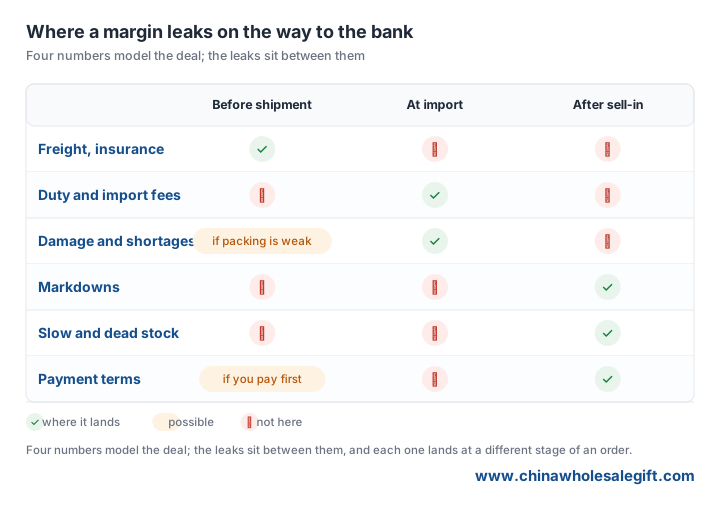
Putting the four together
Combine them into one figure you can compare across SKUs: gross margin in currency multiplied by turns per year, divided by the average stock value you carry. This is a return on the money in inventory, and it ranks SKUs correctly in a way that margin percentage cannot. A cheap watch turning eight times a year can beat an expensive gift set turning twice, even at half the margin percentage.
When a supplier offers a better unit price, run it through all four numbers before agreeing. A lower unit cost with a larger carton may raise landed cost; a lower unit cost with a longer lead time may cut turns; a lower unit cost with a new moulding may raise the defect rate. The quote is one of four numbers, and the other three are the ones that decide whether the order was worth placing.
Sourcing business gifts for your team?
Send your brief and quantity for a quote and a digital proof.
Get a free quote


