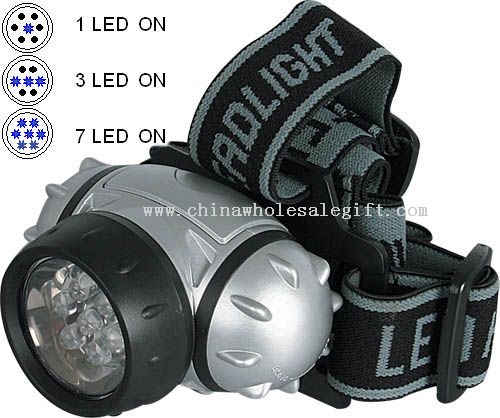
Headlamp Payment Terms: 30/70, LC and Trade Assurance
A headlamp order carries three costs that a handbag or a keychain order does not: tooling for the housing, a battery that decides how the goods can be shipped, and a document set that has to satisfy customs as well as the buyer. The payment term has to fit all three, because the moment the balance is released decides who is holding the risk when the battery paperwork turns out to be incomplete.
What a Headlamp Order Adds to the Payment Question
Most headlamp projects start with a mould. If the housing is new, the tooling is quoted separately and normally paid before sampling, which means the tooling payment is not the same conversation as the production payment. Then there is the light engine: LED bin, driver and switch determine the stated lumens and run time, and those are the numbers the buyer will test. Finally there is the power source, and this is where the payment schedule meets logistics. A lamp running on three AAA cells ships as a normal electrical gift; a lamp with a built-in rechargeable lithium pack ships as dangerous goods with a test summary and a safety data sheet behind it.
30/70 T/T: Tooling First, Balance After Inspection
The 30 percent production deposit buys the components: LEDs, drivers, housings, straps, batteries. It does not buy the mould, which is usually invoiced and paid before the first sample exists. Two clauses keep the arrangement honest.
- Separate the tooling line from the production line. Write the tooling cost, the ownership of the mould and the condition for its return or transfer. If the project ends, the mould should not disappear with the deposit.
- Tie the balance to inspection, not to a photo. A pre-shipment check that measures lumens on a sample, confirms run time, and verifies the battery type against the order is the release condition. Without it, the 70 percent is paid against a picture of a beam on a wall.

LC at Sight: The Document Set Is the Product
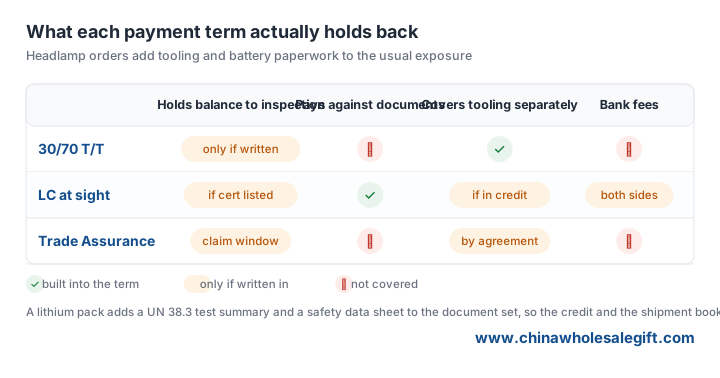
A letter of credit pays against paper, and a headlamp shipment generates more paper than a soft goods order. Expect the credit to call for a commercial invoice, a packing list, a bill of lading, a certificate of origin, a declaration of conformity for CE and RoHS where the destination requires it, and, when the lamp contains a lithium cell, a UN 38.3 test summary and a safety data sheet. Each of those is a separate document with its own issuer, and each one can be the single discrepancy that stops payment.
The practical rules are the same as any credit, but the stakes are higher because the battery documents come from a third party. Confirm before the credit is opened that the factory can produce the test summary for the exact cell it intends to use, not for a similar one. Put the document list in the credit in the factory words, keep quantity tolerances inside the credit, and allow enough time before the expiry date for one amendment, because one amendment is normal and two is a schedule problem.
Trade Assurance: Only as Strong as the Order Text
Platform escrow is a mediation layer, and on a headlamp order it is weakest exactly where disputes happen. A claim about brightness is a measurement argument; a claim about run time depends on the test method; a claim about the battery depends on what the listing said. All three are decided by the order text, not by the platform.
So write the specification into the order itself: LED type and quantity, stated lumens and the method used to measure them, run time at a named mode, battery chemistry and capacity, charging port, IP rating, and the packaging. Add the inspection level and the claim window. On a platform order the specification is the contract, and anything left in the chat is not.
Where the Battery Changes the Payment Schedule
An order using AAA or other dry cells ships without dangerous goods paperwork, which usually means the balance can be released against a copy of the bill of lading and the goods move on the first available flight. A built-in lithium pack changes the chain: the test summary and data sheet have to be ready before booking, some carriers accept only cargo aircraft, and the packing list has to declare the watt-hours. If the balance is due on shipment and the battery documents arrive late, the shipment waits and the payment argument starts.
The fix is sequencing rather than a different payment term: require the battery documents as a deliverable before production, hold a small retention against them, and only then release the balance on shipment.
Clauses to Write Before Any Money Moves
Six lines cover most of the exposure on a headlamp order: the tooling amount, its ownership and its refund condition; the specification with lumens, run time, battery chemistry and IP rating; the inspection level and timing; the document list including the battery paperwork; the shipment window and the consequence for a late booking; and which side pays which bank charges. Add the currency and the Incoterm, and the payment term has something to attach to.
Send the lamp type, the battery you intend to use and the destination, and we will quote the three payment routes with the document set each one requires, so the schedule and the paperwork are agreed before the tooling is cut. Browse the headlamp range to shortlist the housing first.
Sourcing business gifts for your team?
Send your brief and quantity for a quote and a digital proof.
Get a free quote