Headlamp Sourcing Calendar: 6 Lead Times to Plan Around
In a headlamp order, assembly is rarely the bottleneck. The cell is. A rechargeable headlamp cannot ship until the cells are in hand and the shipping documents for a lithium battery are in order, and either of those can move the ship date on its own. Build the calendar around the cell and the rest of the programme becomes scheduling; build it around assembly and the order sits finished in a warehouse waiting for paperwork.
The Battery Cell Is the Longest Pole
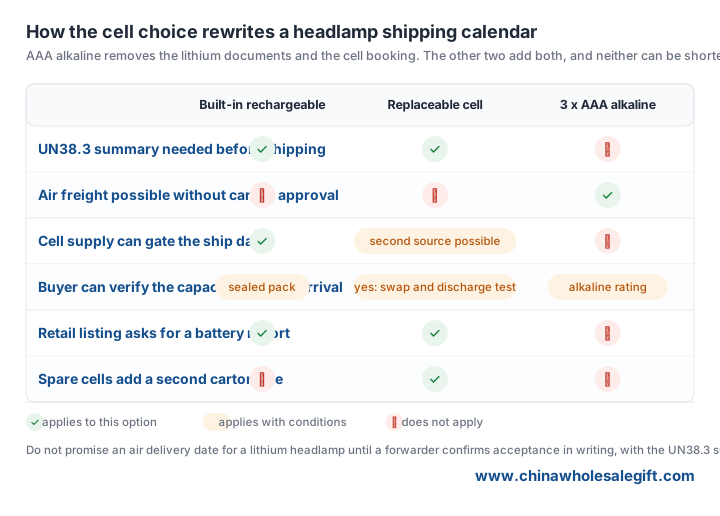
Three cell options cover most promotional headlamps. A built-in rechargeable pack, usually a single cylindrical cell with a protection board. A replaceable cylindrical cell, the same cell in a holder the user can swap. And three AAA alkaline cells, which is the oldest arrangement and still the fastest to ship.
The trade is simple. A built-in pack gives the slimmest housing and the shortest bill of materials, but it makes the cell a fixed part of the product, so a cell shortage stops the line. A replaceable cell lets the customer swap, adds a holder and a contact spring, and gives you a second source. AAA alkaline removes the lithium question completely and costs the most per hour of runtime, because the user buys the cells.
The cell also decides which documents travel with the shipment — the date buyers discover last. The arithmetic is unforgiving: 3,000 units with one cell each is 3,000 cells, and a late cell order does not compress.
Six Dates in a Headlamp Order
Cell booking. The capacity grade, the protection board and the delivery window. A cell is a commodity only in the sense that many factories sell one; the grade you approved in the sample is a specific purchase.
Housing tooling and lens. A new housing needs a mould, and the lens needs its optical pattern, which is cut into the tool. Both can start before the cell arrives if the housing drawing is final.
LED bin selection. Brightness and colour temperature are binned, and the bin you approve is the bin you must buy. A different bin changes the beam appearance in a side-by-side comparison.
Driver and mode firmware. Constant current level, the mode sequence, and whether the switch is a push button or a slide. This is a small board with a long approval cycle if the modes are wrong.
Assembly and water resistance test. Sealing, charging port cover fit, and the water test for any unit carrying a rating. The test needs a drying gap before packing.
Dangerous goods documents and booking. The test summary, the safety data sheet, and a forwarder that accepts the class. This is a date, not a formality.
Lithium Shipping Sets Its Own Deadlines
A headlamp with a lithium cell is a dangerous goods shipment, whatever the marketing copy says. The cell needs a UN38.3 test summary, the shipment needs a safety data sheet, and the forwarder needs to accept Class 9 cargo. Air carriage usually needs the carrier to approve the shipment in advance, and not every carrier does.
The practical consequence for a calendar is a hard rule: do not promise an air delivery date for a lithium headlamp until a forwarder has confirmed acceptance in writing. Sea freight avoids most of the carrier approval problem and takes longer, which moves the production dates backwards by however long the voyage takes. Both paths need the documents ready before booking, and the documents come from the cell maker, not from the assembly factory.
Ask for the test summary with the cell quotation. A supplier who cannot produce it has not shipped this product by air before, and finding that out at booking costs a season.
LED Bin, Driver and Lens: Three Approvals Before Bulk
All three are cheap to approve and expensive to change after tooling. The LED bin is a purchase commitment: a flux bin and a colour bin, written down, with the maker and the part number. The driver is a firmware decision, and the mode sequence is the part buyers notice first, because a headlamp that cycles high-low-strobe instead of low-high-off feels wrong in the hand. The lens pattern is in the tool, so a change to the beam angle is a tooling change.
Approve all three on the same sample, at the same time, under the same light. A beam approved in daylight is not the beam the user sees at night, and a colour temperature approved on a photo is not a colour temperature at all.

Where the Calendar Breaks Without Warning
Two failures repeat. The first is a capacity claim that nobody tested: a cell labelled at one figure and delivering another, discovered by the customer rather than at goods-in. The counter is a discharge test on the sample against the claim, run at the same load the product will see, with the result recorded.
The second is a retail listing requirement that surfaces after production. Some marketplaces ask for a battery test report or a safety document before a listing goes live, and a supplier who has never listed this product does not know which one. Ask the question before the order, not after packing, and put the answer in the same file as the inspection report.
Draw the Calendar Around the Cell, Not the Assembly
Put the cell booking at the left of the calendar, then the tooling and the driver in parallel, then assembly, test, and finally the documents and booking. The two dates that cannot slip are the cell arrival and the forwarder acceptance, and both sit on the critical path whether or not the plan shows them.
Then convert the plan into a table with a document per line: cell test summary, LED bin, driver mode sheet, water test record, dangerous goods declaration, packing list. A date backed by a document can be checked by someone who was not in the meeting.
If you are planning a headlamp programme and want the six dates laid against your delivery window, send the cell type, the quantity and the shipping mode, and we will return the calendar with the lithium documents marked as gating items.
Sourcing business gifts for your team?
Send your brief and quantity for a quote and a digital proof.
Get a free quote


