Headlamp Battery Configuration: AAA vs 18650 vs Built-in
The battery bay decides three things before you look at lumens: how the lamp ships, what it weighs on someone's forehead, and whether the end user can keep it running after the cell goes flat. A three-AAA headlamp is a giveaway that works anywhere in the world because every convenience store sells the cells. An 18650 headlamp is a tool that outperforms it on every measure except the one that matters at the till — the buyer has to own a charger.
Here is the comparison that actually separates them, in energy, weight, cold and freight terms, and the arithmetic you can run before choosing a configuration for a private-label program.
Three configurations, three energy budgets
Three AAA cells give 4.5 V nominal and, on alkaline, roughly 1.0 to 1.2 amp-hours at low drain — around 5 watt-hours on paper. That figure collapses under load: at 500 mA continuous, an alkaline AAA delivers substantially less than its rated capacity, and three of them effectively give you 2.5 to 3.5 watt-hours. The lamp is also the cheapest to build, because there is no charging circuit and no lithium cell.
One 18650 gives 3.7 V nominal at 2,000 to 3,500 mAh, so 7.4 to 13 watt-hours, and it holds voltage under load far better than alkaline. It needs a proper driver, a protected cell or a protection circuit, and a charger in the box or in the customer's drawer.
A built-in lithium cell is usually 3.7 V at 500 to 2,000 mAh, so 1.8 to 7.4 watt-hours, charged through USB. It is the lightest option and the easiest to gift, and it is the one that becomes landfill when the cell degrades, because the cell is not user-replaceable.
Runtime arithmetic that survives a spec sheet
Runtime is energy divided by LED power, with losses. A 3 W emitter on a 9.6 Wh 18650 gives roughly three hours at full output before driver losses, so plan on two and a half. The same 3 W emitter on three AAA at 3 Wh gives about an hour, and less as the cells sag and the driver drops out of regulation.
That is the honest way to read a "10 hours runtime" claim: it is almost always at a reduced output, often a fifth of maximum, after the lamp has stepped down. Ask for the runtime at the output the customer will actually use, and for the lumen figure at the end of that runtime rather than the start. A lamp that begins at 300 lumens and ends at 40 after twenty minutes has a runtime claim and a brightness claim that never coexist.
Weight sits on a forehead, not on a spec sheet
An alkaline AAA weighs about 11.5 g, so three cells are 34 g plus the holder and contacts. A protected 18650 weighs around 47 g. A built-in 1,200 mAh pouch cell is roughly 25 g but needs a sealed housing and a USB port.
For a lamp worn over a cap for an hour, total weight around 100 g is comfortable; past 150 g the strap has to be wider and the lamp starts to migrate when the wearer looks down. If the design puts the cells in the front housing, the weight is on the brow — which is why 18650 lamps usually move the cell to the back plate with a cable. That cable is a failure point, and it is the first thing to test on a sample: flex it at the strain relief a few hundred times and look for the conductor breaking inside the insulation.

Cold, freight and the reason a spec sheet is not enough
Alkaline cells lose a large share of their capacity below freezing — at minus 20 °C you can expect roughly half of the room-temperature figure, and the drop is worse at high drain. Lithium holds most of its capacity at the same temperature. For a work lamp sold into winter markets or for a car emergency kit, that difference is the whole product decision, and no amount of extra AAA cells fixes it.
Freight is the other hard constraint. Three AAA alkalines are not lithium, so the lamp ships as ordinary cargo with the cells installed, subject to short-circuit protection in the packaging. Any 18650 or built-in lithium cell makes the shipment lithium battery cargo: it needs the test summary for the cell, a material safety data sheet, and the correct packing instruction depending on whether the cell is inside the device, packed with it, or shipped loose. Air freight of loose cells is the case that gets refused at the counter, so build the shipping mode into the design rather than discovering it at booking.
Match the configuration to who is buying
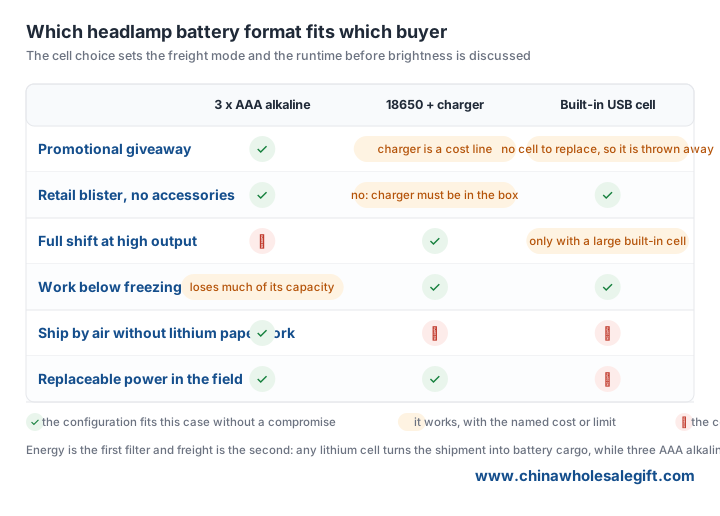
For a promotional giveaway under a few dollars, three AAA is still the right answer: no charger to lose, no lithium paperwork, and the recipient can use it the same day. For a retail blister pack aimed at campers, a built-in USB cell sells better because it needs no accessories and the box can promise "charge from any phone charger". For a professional or industrial buyer, 18650 with a spare cell and a proper charger is the only configuration that survives a shift, and the buyer will ask what the driver does at low voltage.
Ask one question before quoting: is the lamp expected to be used once, or every week for a season? Once means alkaline. Every week means lithium, and the choice between built-in and 18650 comes down to whether the buyer will tolerate a cable and a separate charger.
Put the cell, the runtime and the freight mode on the order
An order that says "LED headlamp, rechargeable" gives the factory four ways to build it. One that says "3.7 V 1,200 mAh built-in cell, USB-C input, 3 W emitter, 2.5 hours at 200 lumens, UN38.3 test summary and MSDS supplied before booking, cell declared inside equipment" gives them one.
Keep one sample per configuration with the measured runtime written on the tag, and re-measure on the first bulk delivery rather than trusting the second spec sheet. Browse the headlamps category to see which battery formats the current range carries, then decide the freight mode before the housing is tooled — that decision is cheap on paper and expensive in a mould.
Sourcing business gifts for your team?
Send your brief and quantity for a quote and a digital proof.
Get a free quote


