Headlamp Reflector Types: Smooth vs Orange Peel
Two headlamps with the same LED, the same battery and the same claimed lumen figure can throw completely different beams, and the difference is usually the texture on the reflector. Smooth and orange peel are not cosmetic variants of one part. They are two different optical decisions, and the one you choose decides whether the lamp reaches down a trail or fills the area in front of a car bonnet.
What orange peel actually is
The texture is moulded into the reflector, not applied afterwards. A smooth insert is polished to a mirror; an orange peel insert carries a fine stipple, produced by etching or spark erosion on the tool steel, and the plastic part copies it. Both are then vacuum metallised with a thin aluminium layer, so the difference in the finished part is purely geometric: a mirror surface, or a mirror surface broken into thousands of tiny facets.
That geometry is fixed at tooling. Changing from smooth to orange peel means a new insert, so it is a decision made once per product, not a setting that can be adjusted in a production run. That is why the texture has to be chosen against the use case before the mould is cut rather than discovered at the sample stage.
Smooth: reach, artifacts and the centring problem
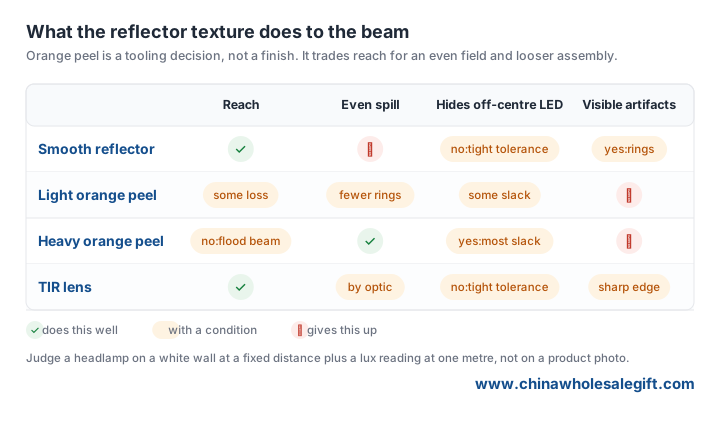
A smooth reflector directs light in a tight, coherent cone. The centre of the beam is intense, the reach is longer for the same LED output, and the hotspot has a hard edge. For a lamp that has to illuminate something fifty metres away, that is the behaviour you want.
The cost is visible pattern. A smooth surface reproduces every imperfection of the light source, so a square LED die projects a square-ish hotspot with rings around it, and an LED that sits a fraction of a millimetre off the focal point throws the beam sideways. Assembly tolerance has to be tight, the reflector and the LED board have to be located by the same datum, and the reject rate on the line is higher. On a cheap lamp that tolerance is where the money went missing, and the symptom is a beam that looks lopsided or has a dark notch in it.
Orange peel: even beam, looser assembly
The stipple scatters light slightly at the surface, which blurs the hotspot edge and fills the rings. The beam becomes a soft, even pool with a gradual falloff, and the artifacts disappear because the surface is no longer reproducing the die shape faithfully. For close work, reading, cooking, repairing something under a bonnet or setting up a tent, that even pool is more useful than a sharp spot, because the eye does not have to keep re-aiming.
The scatter is paid for in reach. Light that is redirected into the spill is light that is no longer in the centre of the beam, so the peak intensity at a fixed distance drops against a smooth reflector of the same size and the same LED. This is the trade in one sentence: orange peel spends centre intensity to buy an even field and a wider useful angle.
The second benefit is manufacturing. A textured surface is far less sensitive to the LED sitting slightly off the focal point, so the assembly can tolerate a looser position and still produce a beam that looks correct. That lowers the reject rate and the cost, which is why orange peel is common on volume promotional lamps and smooth is common on lamps sold on beam performance.
Reading a beam with a wall and a lux meter
Beam claims are easy to check without a lab. Set the lamp two metres from a plain white wall in a dark room, fix it so it cannot move, and photograph the pattern with the camera on manual exposure. What you are looking for: a symmetric hotspot, no dark notch, no concentric rings, and a spill that fades rather than stopping at a hard line. Then move the lamp to five metres and repeat, because artifacts that are invisible at two metres separate clearly at five.
For a number, use a lux meter at one metre on the centre of the beam, and again at the edge of the useful field. The ratio tells you how concentrated the beam is, which is the practical difference between a smooth and a textured reflector. Ask the supplier for the same two readings from their sample, taken at the same distances, and the comparison becomes arithmetic instead of adjectives. Beam angle at half intensity is the other useful figure, since it describes the spill rather than the hotspot.
Matching the texture to the job
Walking or running on an unlit path wants reach and a defined hotspot, so a smooth or very light texture with a deeper cup makes sense, and the user can tolerate some pattern. Working with the hands wants an even pool at close range, where heavy orange peel is better and the loss of throw does not matter. Cycling sits between the two: enough reach to be seen and to read the road, but with a cutoff that does not blind oncoming traffic, which usually means a shaped optic rather than a plain reflector.
Promotional and giveaway lamps have a third consideration, which is consistency at volume. A textured reflector hides assembly variation, so a thousand units look alike. A smooth reflector at a low price point produces a visible spread between good and bad units, and the returns come back as beam complaints rather than as dead lamps.
What to put on the specification
Name the reflector type in words a factory can act on: smooth, light orange peel or heavy orange peel, plus the cup depth and the material. Add the LED package and the locating method, because the reflector and the LED have to be positioned relative to each other, not to the housing. Then add the two measurements that make the claim checkable: lux at one metre on centre, and beam angle at half intensity. A supplier who can quote both numbers has tested the lamp; a supplier who quotes only lumens has tested the LED.
Send the use case and the beam behaviour you need, and we will confirm which reflector texture and cup depth fits it before tooling is cut.
Sourcing business gifts for your team?
Send your brief and quantity for a quote and a digital proof.
Get a free quote