Headlamp Runtime Test: A 4-Hour Protocol
Runtime is the number headlamp buyers quote most and control least. Two factories can both say four hours and mean completely different things: one means the lamp is still producing usable light, the other means the LED is still faintly glowing. A four-hour test settles it, but only if the mode, the battery and the environment are fixed before the first measurement, because a fan in the room or a higher-capacity cell than the one that ships can double the figure without anyone lying.
What runtime officially means
The published flashlight standard, ANSI/NEMA FL1, defines runtime as the time from switch-on until output falls to 10 percent of the initial value, measured with fresh batteries at roughly 21 degrees Celsius in still air. That definition matters because it separates two very different numbers: usable runtime, the period during which the lamp is still bright enough to work with, and total runtime, the point where it technically still emits.
A headlamp with thermal regulation makes the gap wider. On the high mode the driver steps output down once the LED board reaches its temperature limit, often within the first few minutes, so the lamp spends most of the run at 50 to 60 percent of the initial figure. Quoting the initial number as though it lasted four hours is the most common way a runtime claim becomes wrong without being falsifiable.
Decide before the test which figure you are buying: initial output, output at one hour, or the time to 10 percent. Write it into the purchase order. A specification that names only runtime in hours leaves the mode and the definition open, and that is where disputes start.
Setting up the four-hour run
Mode. Test the mode you actually sell as the headline. If the packaging says four hours, find out which mode that refers to, because a low mode at four hours and a high mode at four hours are different products. Run the high mode as a separate test if you need both figures, and never mix results from two modes into one claim.
Battery. Use the cells that will ship, from the production lot, and record the brand and the measured capacity if you can. Alkaline AAA cells lose capacity in cold and sag under load; a lithium-ion cell holds voltage flatter. A test run on a higher-capacity cell than the shipped one is not a test of the product.
Environment. Still air at around 21 degrees Celsius. No fan, no air conditioning vent, no open window. Air movement removes heat from the housing, the driver never throttles, and the runtime figure climbs. Test in a closed room and note the ambient temperature in the report.
Instruments. A light meter at a fixed distance, one metre is the usual choice, on a fixed stand with the lamp in the same orientation every reading. An infrared thermometer for the housing at the LED board. A multimeter for battery voltage at each interval. Mark the stand position on the table so the next lot is measured the same way.
The logging schedule
Four hours is long enough that a single start and end reading hides everything interesting. Log at switch-on, then at 5, 10, 15, 30, 45 and 60 minutes, then every 30 minutes to the end. The dense early readings catch the thermal step-down, which happens in the first quarter of an hour on most regulated lamps, and the sparse later readings are enough to see the battery curve.
At each interval record four numbers: illuminance at the fixed distance, battery voltage, housing temperature at the LED board, and a note on visible flicker or colour shift. That is four columns and no interpretation. Do not average readings and do not skip an interval because the light looks the same.

Reading the light meter and the thermometer together
An illuminance curve that drops in a step is thermal regulation. A curve that slides down steadily is battery sag. The two look different on the same chart and they lead to different fixes: a step means the driver is doing its job and the marketing number needs correcting, while a slide means the cell or the driver efficiency is the problem.
Housing temperature belongs on the same timeline. A lamp that reaches a high housing temperature in ten minutes and holds flat output is a better design than one that stays cool because the driver is throttling to 30 percent, even though the second one feels safer in the hand. Record the maximum temperature rather than the average, since the peak is what a wearer feels on the forehead.
Battery choice moves the number more than the LED
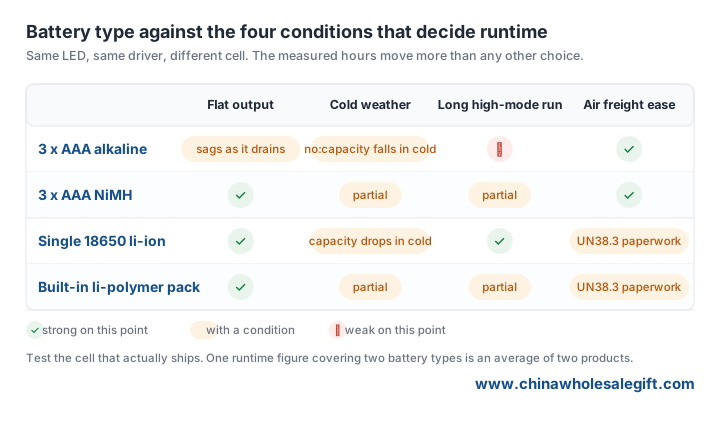
Three AAA alkaline cells are cheap, familiar and available anywhere, and they are also the most temperature-sensitive option: output sags as the cells discharge and falls off faster in cold. Nickel-metal hydride AAA cells hold a flatter curve for most of the run and then drop sharply at the end. A single lithium-ion cell delivers the longest high-mode run and travels badly unless the shipment carries the required test documentation. A built-in lithium-polymer pack removes the user choice entirely, which simplifies the retail story and makes the pack the failure point at end of life.
Test the battery type you ship, and if a customer asks for two battery options on the same body, test both and quote them separately. One runtime figure covering two cell types is an average of two products.
What the report should contain
Mode, battery type and brand, ambient temperature, instrument distance, the full logging table, the time to 50 percent of initial output, the time to 10 percent, and the maximum housing temperature. Add the batch or sample number, because the next comparison is what makes the report worth keeping.
Browse the headlamp range for the body and battery layouts these tests apply to, then send the mode, the cell type and the runtime you need to hold for four hours, and we will return a logged run on the actual shipped configuration so the claim on the packaging matches the lamp inside it.
Sourcing business gifts for your team?
Send your brief and quantity for a quote and a digital proof.
Get a free quote


