Men Watch Battery Life Claims: How to Test a 3 ATM Watch
A battery life claim on a quartz watch is arithmetic, not a promise, and most of the claims in a wholesale catalogue can be checked against three numbers: the cell capacity, the current the movement draws, and the load the calendar or chronograph module adds. A 3 ATM rating is a separate question about seals, and buyers regularly conflate the two, which is how a watch ends up described as suitable for swimming because it has a long battery life. Here is how to test both before the order is placed.
What 3 ATM Actually Certifies, and What It Does Not
3 ATM is a static pressure rating equivalent to 30 metres of water, and in practice it means splash resistance: rain, hand washing, a wet counter. It does not mean swimming, and it does not mean showering, because both add movement and heat that a static rating does not cover. The rating is a test of the case, the gasket and the crown, not of the movement.
The crown matters more than the number. A 3 ATM watch normally carries a push-pull crown rather than a screw-down crown, and a push-pull crown that is left out after setting the time is the most common route for water to enter. If the marketing copy says the watch can be worn in water, that sentence has moved beyond what a 3 ATM rating supports, and it is worth correcting before the copy reaches a distributor.
The Arithmetic Behind Any Battery Life Claim
Battery life in a quartz watch is cell capacity divided by average current draw. Capacity is quoted in milliamp hours on the cell datasheet, draw is quoted in microamps, and the units have to be reconciled once: multiply the capacity by 1000 to get microamp hours, then divide by the draw to get hours.
A worked example with round numbers: a cell rated at 20 mAh is 20,000 microamp hours. At an average draw of 2 microamps, that is 10,000 hours, which is a little over 400 days. Change the draw to 3 microamps and the same cell gives about 6,700 hours, or a bit over 270 days. That is the whole sensitivity of the claim: a one microamp difference moves the answer by months, and no catalogue photograph shows which of the two draws your watch actually has.
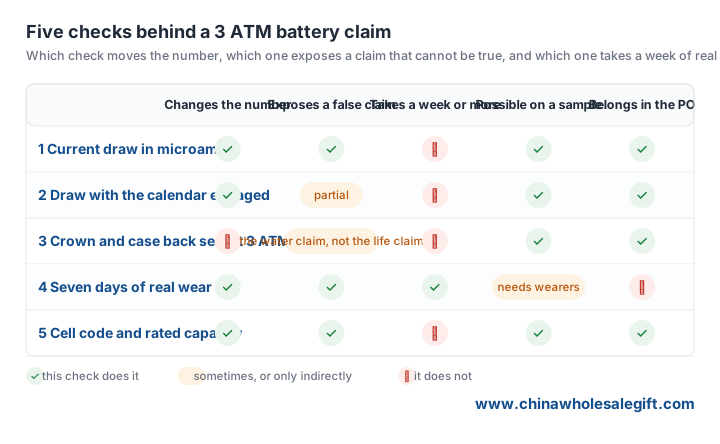
Check 1: Measure the Draw, Not the Claim
Open the case back, lift one side of the cell contact, and put a microamp meter in series with the cell. Read the draw with the watch running normally, then compare it with the movement datasheet. This is a two-minute test with the right meter and it replaces an argument about whether two years is realistic.
Two practical notes. First, a meter with a burden voltage that is too high will stall the movement, and a stalled movement draws almost nothing, which reads as an excellent result and is meaningless. Second, the draw is not constant: it pulses when the stepper motor advances, so a reading that jumps is normal and the number to record is the average over half a minute rather than the lowest value on the display.
Check 2: The Calendar Module Is the Hidden Load
A calendar or day-date module advances a disc once a day, and that advance is a brief high-current event rather than a steady draw. On a basic three-hand movement the effect is small; on a watch with a big date wheel or a moon phase it is not. Measure the same watch with the calendar engaged and with the movement held in a time-set position, and compare. The gap is the cost of the complication, and it belongs in the battery life claim.
This is where a claim written for a three-hand watch gets copied onto a calendar model. The cell is the same, the movement family is the same, the case is the same, and the life is not, because the module is doing work every night. Ask the supplier which movement reference the claim was calculated on, and match it to the drawing rather than to the catalogue page.
Check 3: The Seal and the Crown at 3 ATM
The seal check is separate from the battery question but sits on the same specification line, so test it at the same time. Inspect the case back gasket for a clean seat with no twist, check that the crown sits flush when pushed home, and confirm the pushers, if any, return fully. A watch with a chronograph pusher that does not return is no longer a 3 ATM watch, whatever the case back says.
For a sample, a simple water test is enough: a shallow bowl of water at room temperature, the watch immersed for a few minutes with the crown pushed home, then the case opened and inspected for moisture at the gasket. Do not use hot water, because the expansion it causes tests something else entirely. A watch that passes this is not certified, but a watch that fails it will never pass a pressure test.

Writing the Claim Into the Specification
A claim that survives an order has four parts written on the same line: the movement reference, the cell code, the measured average draw in microamps, and the resulting life in months with the arithmetic shown. Anything shorter is a number copied from a supplier catalogue, and it will be repeated by your distributor with your brand on it.
Add the seal inspection as a separate line, with the crown type named. Then test five units from the bulk run against the same four numbers, because movement draw varies by batch and a cell code can be substituted without the case changing. When the numbers match, the claim is yours to make; when they do not, you have found the substitution before the shipment rather than after it.
Send us the movement reference and the cell you intend to use, and we will measure the draw and return the arithmetic for a sample from the men watch range before you print a battery life figure on the box.
Sourcing business gifts for your team?
Send your brief and quantity for a quote and a digital proof.
Get a free quote


