Power Bank Wholesale Compliance: UN38.3 and MSDS Pack
A power bank quote without a document pack is a quote for a box that cannot legally fly. The hardware is the easy part: cells, a boost board, a shell and a logo. What stops shipments is paper — a test report that names a different cell, an MSDS that describes the wrong chemistry, or a declaration missing the state-of-charge statement the airline wants.
This guide covers the four documents that travel with a lithium power bank order, the one check that catches most bad reports, and the rule that decides whether your cartons go by air at all.
The four documents that travel with the goods
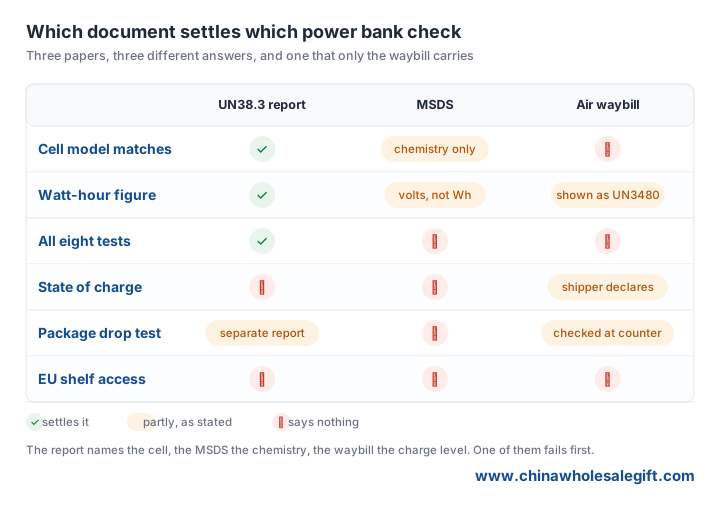
The UN38.3 test summary. Section 38.3 of the UN Manual of Tests and Criteria defines eight tests every lithium cell and battery must pass before transport: altitude simulation, thermal cycling, vibration, shock, external short circuit, impact or crush, overcharge and forced discharge. The report is issued per cell and per battery design, and it is the document a forwarder will ask for first.
The MSDS or SDS. Sixteen sections, written to the GHS format, describing the cell chemistry, the hazards, the fire response and the transport classification. It is not a substitute for the UN38.3 report and the report is not a substitute for it; forwarders ask for both because one describes the design and the other describes the material.
The dangerous goods declaration. For sea freight and for air cargo, the shipper declares the consignment under UN3480 for batteries shipped alone or UN3481 for batteries packed with or contained in equipment. A power bank in its own retail box, shipped as a carton of power banks, is UN3480.
The packaging drop test and the lithium battery mark. Lithium battery packages must survive a 1.2 metre drop without damage to the cells, and the carton carries the lithium battery mark with the UN number and a telephone number for information. The artwork is supplied by the shipper, and it is checked at the counter, not at the destination.
The one check that catches most bad reports
Open the report to the first page and compare three fields against the power bank you are buying: the cell model number, the rated capacity in watt-hours, and the name of the test laboratory. Then open the bill of materials from the factory and compare the cell model again. Reports get reused across products, and the reuse is usually visible on page one.

Watt-hours are the number that matters, not milliamp-hours. A 10,000 mAh pack at a nominal 3.7 volts is 37 Wh; the same 10,000 mAh printed on a 5 volt basis is 50 Wh. Both are under the 100 Wh line that separates a Section II shipment from a fully regulated one, but a 26,800 mAh pack is close to it, and packs built from two cells are over it. If the report lists a Wh figure that does not match the arithmetic, the report belongs to another product.
Two more lines are worth reading. The report should show all eight tests, not only the four that are cheap to run, and the test summary should be signed and dated within a period your forwarder accepts. A report older than the cell it describes is a report for a discontinued part.
Air, sea and the state-of-charge rule
Lithium ion batteries shipped alone are forbidden as cargo on passenger aircraft; they move on cargo aircraft only. That single rule changes routing and cost more than any document does, and it is the reason a supplier quoting "air freight included" is usually quoting a forwarder who will consolidate the cartons into a cargo-only movement.
Under Section II of Packing Instruction 965, cells and batteries at or below 100 Wh may ship with reduced marking, on one condition that catches buyers every season: the state of charge must not exceed 30 percent of rated capacity. A factory that charges packs to full before packing — which many do, because it makes the demo work — has produced a consignment that cannot be declared under Section II. Put the 30 percent rule in the purchase order, and ask for the charging record, not just the promise.
Sea freight is more forgiving on state of charge and stricter on documentation volume: the declaration, the MSDS and the report travel with the booking, and the container needs the Class 9 placard if the consignment is fully regulated.
Market files are separate from shipping files
Everything above gets the goods onto a plane or a ship. It does not get them onto a shelf. For the EU, a power bank needs the CE marking route with EMC and RoHS evidence, and it falls under the EU Battery Regulation, which now sets its own labelling and due-diligence expectations. For the US, the FCC rules cover the charging electronics, and retailers frequently ask for a UL 2056 report on the power bank itself. Japan wants PSE, Korea wants KC, India wants BIS registration. Cell-level safety is usually evidenced by IEC 62133.
These are separate files from the transport pack, issued by different labs on different cycles, and they are the ones that turn a three-week order into a three-month one. Ask which of them the factory already holds for the exact model, and which need a new application.
What to ask for before the deposit
One email, five attachments: the UN38.3 test summary with the cell model and Wh on page one, the sixteen-section MSDS, the drop test report, the lithium battery mark artwork, and the market certificates the factory already holds for this model. Ask for the state-of-charge procedure in writing as the sixth item.
When something is missing, the useful question is not whether the factory can supply it but how long a new test takes for this cell, because a new UN38.3 cycle is a laboratory booking, not a document request. A supplier who answers that question with a date is a supplier who has shipped lithium before. One who answers with a promise is asking you to carry the risk of a container that stops at the port.
Sourcing business gifts for your team?
Send your brief and quantity for a quote and a digital proof.
Get a free quoteRelated products
 portable power bank for Iphone ipad ipod SmartPhone or USB deviceCWG50728
Credit Card-Size Power BankCWG57296
 Fruits Design Universal 3000mah USB Power Bank for smart PhoneCWG58498
 5000mah magic mirror power bank smart universal power bankCWG58502
 Engraved or printing logo crystal power bank with LED LightingCWG59083