Rhinestone Keychain Stone Loss: How to Test Setting Quality
Rhinestone keychains lose stones for one of three reasons, and they need three different tests to find out which: the glue let go, the prong opened, or the foil behind the stone dulled until the stone looked grey. Testing one stone by pulling it off tells you almost nothing about the other two, which is why bulk buyers end up with a carton of claims that the factory cannot reproduce.
Why Stones Come Off
A rhinestone sits in a cavity in the metal or acrylic base, held by either claws that fold over the stone's edge or adhesive that bonds the stone to the cavity floor. Claw settings fail when the claw is too thin to hold its fold, or when the plating under the claw flakes and the claw loses its grip. Glued settings fail when the adhesive sees heat or humidity, or when the cavity is not clean before the stone goes in — a trace of polishing compound is enough to make the bond release months later.
Foil is the third failure that gets mistaken for stone loss: the reflective coating on the back of the stone hazes or lifts, and a stone that is still firmly attached reads as dull. Buyers report that as "stones falling out" because the count looks wrong from a metre away.
The Setting Type Decides Most of It
Ask which setting the sample uses before you test, because the tests differ. A prong-set stone should be judged on claw thickness and how the claw tip is rounded; a glued stone should be judged on the adhesive and on whether the cavity was masked during plating, since a plated cavity is a smooth, low-grip surface. A bezel or rim setting, where metal is rolled over the stone's edge all the way around, is the most secure of the three and the most expensive to produce.

On a densely set item, the failure you will actually see is cumulative: one stone lifts, the empty cavity catches light differently, and the whole piece looks defective. That is why the tests below count stones rather than judging the piece as a whole.
Test 1: The Single-Stone Pull
Use a small force gauge with a hook, or a spring scale, and pull one stone straight up and away from the setting. Do it on ten stones spread across the piece, not on the ten in one corner, and record two things: the force at which the stone releases, and what failed — the glue line, the claw, or the stone itself breaking.
The number matters less than the pattern. A wide spread between stones means the bonding process is inconsistent, which is a process problem and will show up as random losses. A tight spread at a low value means the whole batch is under-bonded. Compare both against a reference piece you have already accepted, and keep the gauge reading in the inspection record.
Test 2: Warm Water and Detergent
Soak the piece in water at about 40°C with a few drops of mild detergent for 30 minutes, dry it, then repeat the pull test on a fresh set of stones. This is the test that catches adhesive chosen for dry conditions: epoxy softens slowly and the bond drops by half without any visible change, while a properly cured structural adhesive barely moves.
It also catches plating failures that only appear when wet. Look at the claw tips under a loupe after the soak — lifting plating there is the start of a claw that will open in a pocket.
Test 3: Rub and Tumble
Rub a dry cotton cloth across the stone field 100 times with light pressure, then count the stones that moved and look at the foil under a lamp. Hazed foil shows as a stone that has turned flat grey while still being attached. Then put the keychain in a small drum with a bunch of keys and tumble it for five minutes, which reproduces a month of pocket and handbag wear in one afternoon.
Count stones lost, stones loosened, and scratches on the plating at the prong tips. A piece that survives the tumble with no losses and no scratches is a piece that will survive retail handling, which is where most damage actually happens.
Recording a Pass
Write the result as three lines per test: stones tested, stones failed, and the failure mode. "Stones secure" is not an inspection result; "10 pulled, 0 released at reference force, 1 claw opened at 60% of reference" tells the next inspector exactly what to look for.
The matrix below shows why the three tests are not interchangeable — each one reaches a different failure, and only the tumble finds plating wear at the claw tips.
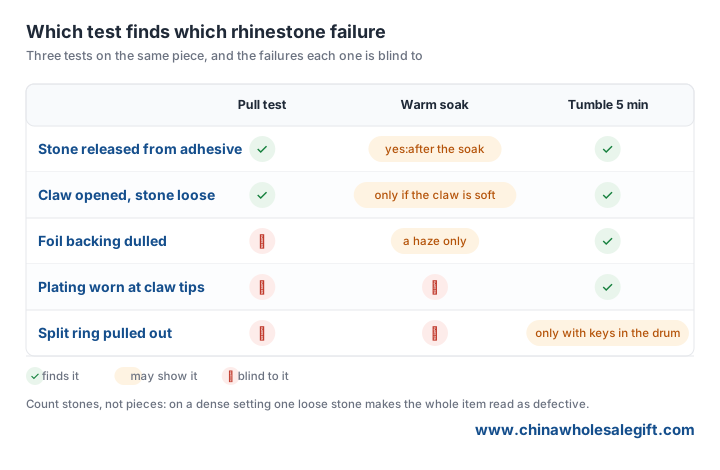
When you order rhinestone keychains, specify the setting type and the adhesive in the purchase order, and ask for these three results on a pre-production sample plus one piece from the bulk carton. On a densely set item the claim rate is decided by the worst ten stones, not the average one.
Sourcing business gifts for your team?
Send your brief and quantity for a quote and a digital proof.
Get a free quote


