Silicone Watch QC: 4 Stretch and Color Tests
Silicone watch QC is usually run as a look-and-feel check: the strap feels soft, the colour looks right, the buckle closes. That passes a sample and fails a container, because the two properties that generate complaints — a strap that sags after a month and a colour that does not match the previous order — are invisible on the day of inspection. Four measurable tests cover them.
Why Silicone Watch QC Is Not a Visual Check
Silicone is a formulation, not a single material. Two straps can look identical and differ in Shore hardness, tensile strength and how much plasticiser or filler went into the mix. A soft strap that feels pleasant in the hand may be under-cured, and an under-cured strap creeps: it takes a permanent set where it bends at the lugs.
The second trap is colour. Pigments are batched, and a new batch of the same colour code can land slightly lighter or warmer. On a single sample nobody notices; on a reorder that ships beside last season stock, the difference is the first thing a retail buyer sees.
Both problems are cheap to catch. A durometer, a tape measure, a colour meter and a piece of tape cover most of it, and none of them requires a laboratory.
Stretch and Recovery: The Test That Predicts a Sagging Strap
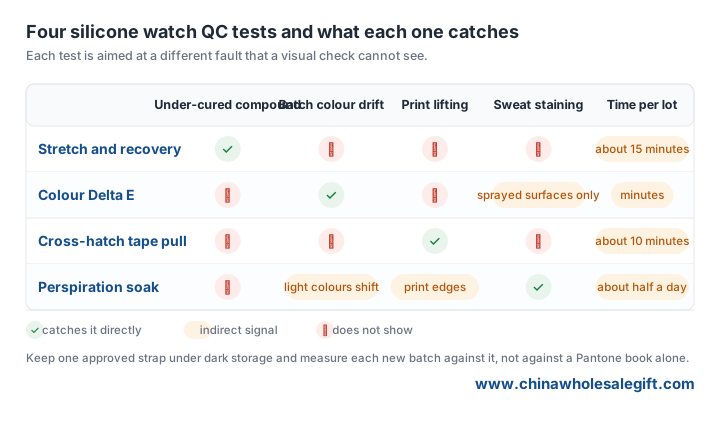
Cut a 100 mm length of strap, mark two points 50 mm apart, and stretch it to 100 mm — 100 percent elongation — for five minutes. Release, wait ten minutes, and measure again. A good silicone strap returns to within 2 to 3 mm of the original mark. A strap that stays 6 mm or more longer has taken a set and will sag at the lug within weeks of wear.
Record the Shore A hardness on the same sample. Watch straps normally sit between 50 and 60 Shore A: softer than 45 and the strap rolls at the buckle, harder than 65 and it feels like plastic and cracks at the pin holes. Durometer readings vary with the operator, so take three readings along the strap and use the middle value.
Tensile strength and elongation at break belong on the material certificate rather than the inspection sheet. For reference, silicone watch strap compounds commonly run 5 to 10 MPa tensile with 300 to 500 percent elongation at break. If the certificate shows numbers well below that band, the compound has too much filler and the stretch test above will confirm it.

Colour Match: Reading a Number Instead of an Impression
Colour difference is expressed as Delta E, and the useful threshold is simple: below about 1.0 the eye cannot separate two samples, between 1.0 and 2.0 a trained eye can see it side by side, and above 2.0 a customer sees it without being told. For a promotional watch that ships as a set, keep the batch-to-batch tolerance at 2.0 or tighter.
Measure against a retained standard, not against a Pantone book alone. Keep a physical approved sample from the first order under dark storage, and measure each new batch against it. Pantone gives the target; the retained sample gives the tolerance.
Lighting matters. Factory inspection under warm LED hides a blue shift; daylight or a D65 lamp exposes it. Measure in the same light every time, and record whether the strap is matte or glossed, because a sprayed surface reads darker than the bare compound of the same colour.
Paint Adhesion and Sweat Staining
Printed logos and sprayed colour on silicone are the weak point of the whole product. Test adhesion with a cross-hatch: cut a 1 mm grid through the print with a blade, press adhesive tape over it, and pull at 45 degrees. If more than a few percent of the squares lift, the surface was not properly primed or plasma-treated before printing.
Sweat is the second attack. Immerse the strap in a perspiration solution at 37 C for four hours, dry it, and compare against an untreated control. Silicone itself does not stain easily, but printed areas and light colours on a sprayed surface can shift, and metal buckles can leave a grey mark on the strap where they touch.
Do this test before the order, not after. It takes half a day and it is the difference between a printed strap that lasts a summer and one that comes back as a complaint about the logo rubbing off.
Turning the Four Tests Into an Inspection Sheet
One page is enough. List the four tests with the sample size, the pass limit and the person responsible, and attach the retained colour standard. AQL sampling decides how many units to pull; the tests decide what to do with them.
Set the stretch test at three straps per lot, the colour check at one reading per lot against the retained standard, cross-hatch on every printed colour, and the soak on one strap per colour per order. That is roughly an hour of work on a 1,000-piece run and it produces a record you can compare across orders.
Then decide what failure means before the run starts. A colour reading of 2.5 on a stocked colour is a rework conversation; the same reading on a one-off promotional colour may be acceptable if the client signs off on a physical sample. Writing that rule down in advance stops the argument at the loading dock.
Finally, keep the approved sample and its readings with the order file. When a reorder is placed six months later, the numbers answer the question that photos cannot.
Browse the silicone watch range for strap colours and buckle styles, then send your colour reference and print artwork for a QC plan.
Request a free sample and quote with your strap colour, print requirement and target quantity, and we will run the four tests on your sample before the production run is booked.
Sourcing business gifts for your team?
Send your brief and quantity for a quote and a digital proof.
Get a free quote


