Wholesale MOQ and Mixed Pallets: How to Combine 20 SKUs
Mixing 20 SKUs into one shipment is the standard way to hit a supplier's minimum without holding 20 separate stocks. It also creates a cost that never appears on the price list: someone has to break layers, pick cartons one by one, and rebuild a pallet that still survives a container. That labour is where mixed orders quietly lose the margin they were meant to protect.
Start from the pallet, not from the product list
A pallet is a fixed volume, and everything else follows from it. The common footprints are 1200 × 1000 mm and 1200 × 800 mm, with a practical load height of about 1.8 to 2.0 m once you allow for the pallet itself and a top cap. That gives roughly 1.8 to 2.4 cubic metres of stacked cartons per pallet before any pattern loss.
Now divide by 20. If a pallet holds 60 cartons in a clean pattern, 20 SKUs means three cartons each — and no pallet pattern survives three cartons per SKU without void fill, corner protection and a lot of tape. The first useful decision is therefore arithmetic, not commercial: either the SKUs share cartons of similar footprint so layers can be built from more than one product, or the order moves from one pallet to several, or the SKU count comes down.
Cartons per SKU must respect the layer
Most pallets are built in layers, and a layer is only stable when it is complete. That single fact sets the real per-SKU minimum in a mixed load: enough cartons to fill at least one layer, or a count that divides evenly into one. Ask the supplier for the cartons per layer for each SKU before you allocate quantities — it is a different number for a 101-piece tool set in a heavy carton and for a boxed keyring, and it changes the whole plan.
Where a full layer is too much, two options work. The first is a shared layer: two SKUs with the same carton footprint and similar weight split one layer between them, which keeps the pallet square. The second is a smaller inner pack, so the same product ships in half-height cartons and a layer carries twice the SKU count.

Layer mixed or case mixed: pick the cheaper failure
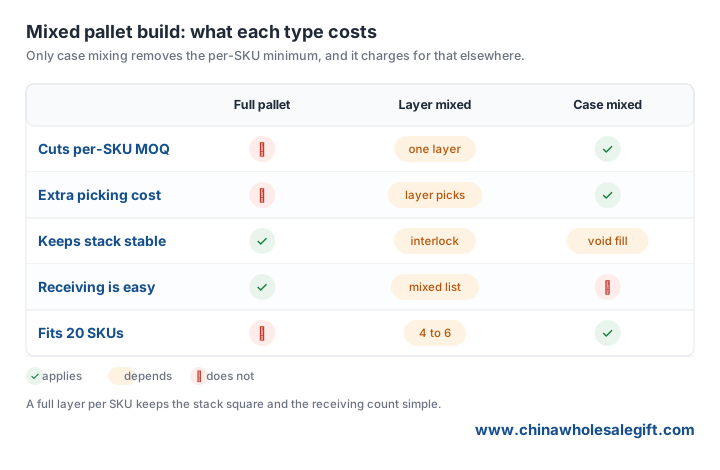
There are two ways to build a mixed pallet and they fail differently. In a layer-mixed build, each SKU occupies complete layers; the pallet is stable, the picking is simple, and each SKU needs enough cartons to fill a layer. In a case-mixed build, cartons are picked individually to any count; the per-SKU minimum drops to a single carton, but the pallet is now a mosaic held together by void fill, and the receiving warehouse has to check a mixed packing list line by line.
Case mixing is the right answer when the goal is a first order small enough to test the market. Layer mixing is the right answer when the order will repeat, because a stable pattern protects the goods and the counting is done once at the factory. Choosing case mixing for a repeat order usually means paying the picking cost every time for no benefit.
What mixing does to the price
Three costs appear the moment an order becomes mixed. Picking is charged per carton or per SKU picked, so 20 SKUs at three cartons each carries 60 picking events. Pattern loss is the volume you cannot use because cartons of different sizes leave gaps, which shows up as extra pallets or unused container height. Documentation is the third: a mixed load needs a packing list that matches carton marks, and every mismatch becomes a receiving dispute.
Containers make the same arithmetic at a larger scale. A 40-foot high cube holds about 67 to 68 cubic metres, but the limit that usually binds first is payload, around 26 tonnes. Ten furniture-weight categories and ten light gift categories in one box is a volume-and-weight balancing exercise: put the heavy cartons on the floor layer and the light ones above, and check the axle distribution before the box is sealed.
Write the build into the order
A mixed order only repeats when the build is documented. Put four things on the purchase order: cartons per layer for each SKU, the layers or cartons allocated to each, the pallet footprint and maximum height, and the carton mark format. Then ask for a photo of the finished pallet before it leaves the factory — one photo catches a collapsed pattern far cheaper than a claim at destination.
Keep the SKU count realistic as well. Twenty SKUs on one pallet is a stunt; six to eight anchors per pallet with two or three rotating items is a system you can run monthly. The household tool set range works well as an anchor because the cartons are uniform and heavy, which lets lighter gift items ride above them instead of forcing a second pallet.
Sourcing business gifts for your team?
Send your brief and quantity for a quote and a digital proof.
Get a free quote


